
The safest edible dose is the smallest one: Health Canada advises looking for edible products with 2.5 mg of THC or less, then waiting before you take more. A 10 mg package is the legal ceiling for the whole package, not one serving. The label tells you the THC in each piece, so the sums are simple once you know where to look. This guide covers the label math, timing, gummies and chocolate, high-THC products, and what to do if an edible hits too hard. It is written for adults in Canada who want a good experience on the first order and every order after.
TL;DR
- Start with 2.5 mg of THC or less, the figure Health Canada and the Council of Chief Medical Officers of Health both give for edibles.
- Read “Total THC per unit” on the label, then multiply by the number of pieces to get the whole package.
- Wait at least two hours before a second 2.5 mg dose. Full effects can take up to 4 hours.
- Licensed edibles in Canada are capped at 10 mg of THC per package. Products with far more THC are extracts, not edibles.
- If you or someone else has taken too much and feels unwell, call the BC Poison Control Centre, call 911 or go to an emergency department.
Table of Contents
- What counts as a dose
- How to read the label: per unit versus per package
- Why edibles feel different from smoking or vaping
- A step-by-step way to find your dose
- Why the same dose lands differently on different people
- Low-THC and high-THC edibles in Canada
- Gummies and chocolate: dosing by format
- If you have taken too much
- Where to find labelled edibles
- FAQ
- Sources
What counts as a dose
People often ask for a number that fits everyone. There isn’t one, but there is an official starting point. Health Canada’s guidance says to look for edibles with 2.5 mg of THC or less. The Council of Chief Medical Officers of Health gives the same figure: start with small amounts and wait until you feel the effects before taking more.
THC (tetrahydrocannabinol) is the compound in cannabis that causes the high. A milligram is a thousandth of a gram, so 2.5 mg is a very small amount. That is the point. With edibles you can always add more later, but you cannot take it back.
A useful way to think about it is as a ladder with rungs of 2.5 mg:
| Total THC | What it is made of | Typical use |
|---|---|---|
| 2.5 mg | One piece at 2.5 mg per unit | First time, low tolerance, or a gentle evening |
| 5 mg | Two pieces at 2.5 mg, spaced by at least two hours | A step up once you know how 2.5 mg feels |
| 7.5 mg | Three pieces at 2.5 mg, spaced out over a session | Only after you know how you respond to 5 mg |
| 10 mg | Four pieces at 2.5 mg, the entire legal package | Experienced users who have worked up to it |
The table is arithmetic on the official unit, not a prescription. The rule that holds for everyone is to move one rung at a time and only after the previous dose has fully played out.
How to read the label: per unit versus per package
The most common edible mistake is mixing up the two numbers on a package. Health Canada explains that the front of the label must show total THC and total CBD. Its example: a package of 4 edible pieces marked “Total THC per unit 2.5 mg” holds 10 mg of THC in total, which is 2.5 mg multiplied by 4 pieces.
Here is the routine:
- Find “Total THC per unit” on the front of the label. This is what one gummy, square or piece contains.
- Count the pieces in the package.
- Multiply the two numbers to get the package total.
- Decide how many pieces make your dose. For a first try, that is one piece if the label says 2.5 mg, or part of a piece if the label says more.
A few worked examples:
| Label says | Pieces | Whole package | Your first dose |
|---|---|---|---|
| 2.5 mg per unit | 4 | 10 mg | 1 piece (2.5 mg) |
| 2 mg per unit | 5 | 10 mg | 1 piece (2 mg) |
| 5 mg per unit | 2 | 10 mg | Half a piece (2.5 mg), if the piece can be divided evenly |
| 10 mg per unit | 1 | 10 mg | Do not start here if you are new to edibles |
The per-unit figure is the one that matters for a serving. The package total only tells you what you would take if you ate everything.
CBD (cannabidiol) is listed alongside THC. It does not cause a high, and it has its own dosing logic. If CBD is what you are after, our CBD dosage guide covers it separately.
Why edibles feel different from smoking or vaping
With an edible, the THC does not go straight to your lungs and bloodstream. The BC government’s Cannabis Edibles Fact Sheet explains that it travels first to the stomach, then the liver before reaching the blood and brain. The liver converts THC into a stronger form, and that adds to the intensity of the high.
Three timing facts follow from this, all from official sources:
- Onset: the same BC fact sheet says it takes 30 minutes to 2 hours to begin feeling effects.
- Peak: it can take up to 4 hours to feel the full effects.
- Duration: intoxicating effects can last up to 12 hours, and residual effects up to 24 hours, according to the fact sheet. The Canadian Centre on Substance Use and Addiction gives the same ranges.
The delay is where most bad experiences begin. Health Canada’s current edible warning, in effect since March 12, 2025, says that eating or drinking more cannabis before you feel an effect can cause cannabis poisoning, including severe anxiety and panic attacks. For a closer look at timing, see our page on how long edibles take to kick in.
A step-by-step way to find your dose
This routine keeps you in control, and it works for first-timers and for experienced users trying a new product.
Step 1: Choose a product with a clear per-unit THC figure
Pick an edible where the dose is already divided into pieces. Gummies and small chocolates make this easy because the label gives you a number per piece. If you are browsing, our edibles collection is organized by type, and our team can answer questions about a product before you order.
Step 2: Start at 2.5 mg or less
This is the figure Health Canada and the chief medical officers give. If you are sensitive to substances, anxious about the experience or have not used cannabis in a long time, a smaller amount than 2.5 mg is reasonable too.
Step 3: Plan the session
Choose a time with nothing to do afterwards. The CCMOH reminds consumers not to drive or operate heavy equipment after using cannabis, and edible effects can last many hours. Eat something before, as the BC fact sheet lists an empty stomach among the factors that change how an edible feels.
Step 4: Wait at least two hours
The BC fact sheet advises waiting at least two hours before taking a second 2.5 mg dose. Set a timer when you eat the piece. Do not judge the dose by the first 30 minutes.
Step 5: Write it down
Note the product, the milligrams, the time and how you felt at hours one, two and four. After two or three sessions you will know your own number, and that is worth more than any chart.
Step 6: Move up one rung at a time
If 2.5 mg did little after the full wait, try 5 mg next time, not 10 mg. Change one thing at a time so you know what caused what.
Why the same dose lands differently on different people
The BC fact sheet names the factors that affect an edible: weight, metabolism, sex and whether you have eaten. Your own history with cannabis matters too, and so does the product itself. Two people can eat the same 5 mg gummy and report very different experiences, which is why published “beginner” and “expert” ranges are a starting guess rather than a rule.
Two habits help. First, keep the same product while you calibrate, so you are not changing both brand and dose. Second, do not combine an edible with another cannabis product in the same session until you know how the edible alone feels.
Adults over 55
Health Canada’s guidance for adults over 55 is to begin with the lowest amount of THC and CBD available and to choose edibles, capsules, softgels or lozenges with 2.5 mg of THC or less per unit. It also notes that full effects can take up to 4 hours. If you take prescription medication or have a health condition, talk to your doctor or pharmacist before using cannabis.
Low-THC and high-THC edibles in Canada
What “low dose” means on a shelf
A low-THC edible is one with a small amount per piece, such as 2.5 mg or less, which matches the starting dose above. These are the products to look for when you want a mild, social or first-time experience. If you prefer to keep the whole experience mild, our guide to low-THC strains covers the flower side of the same idea.
Why a “high-dose edible” has a hard ceiling here
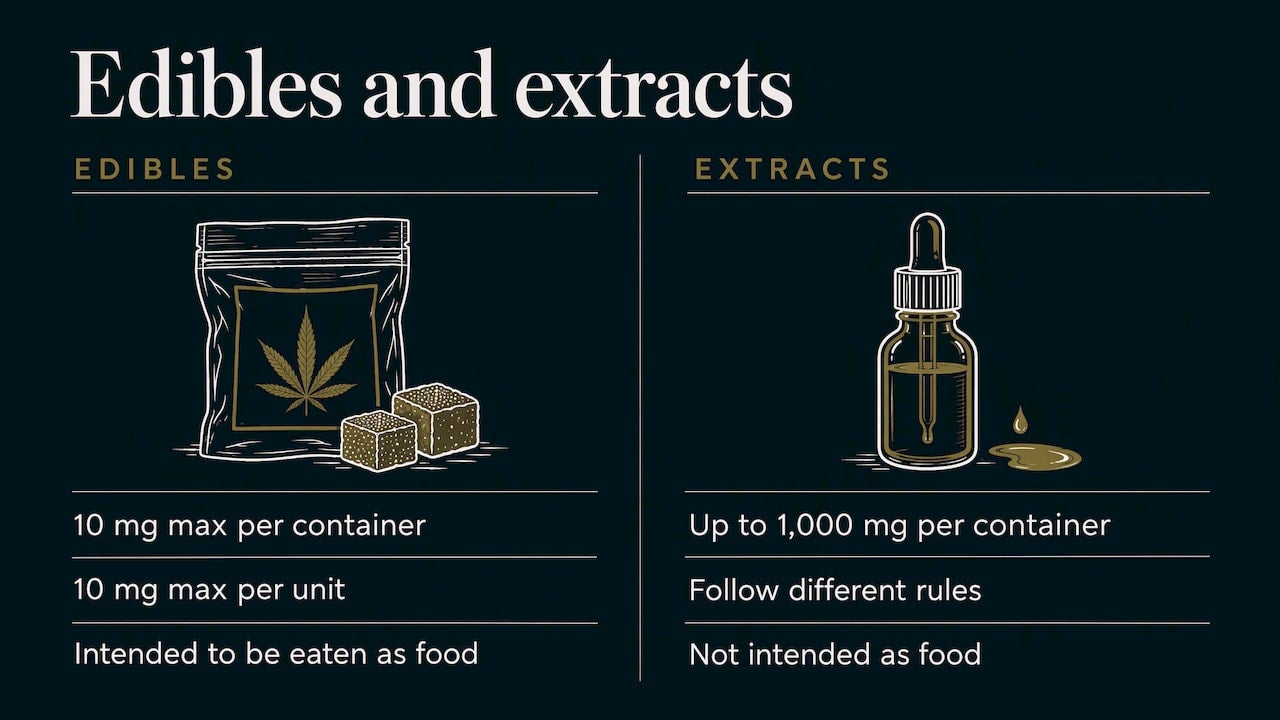
People searching for high-THC edibles in Canada often expect the large numbers seen elsewhere. Canadian rules are different. Section 102.7 of the Cannabis Regulations says edible cannabis must not contain more than 10 mg of THC per immediate container, taking into account the potential to convert THCA (the raw, non-intoxicating form) into THC. Health Canada’s composition requirements guide adds that for products in discrete units meant for ingestion, no single unit may exceed 10 mg.
The March 2025 amendments changed packaging and labelling, but the THC limits stayed the same, including 10 mg for edibles. So a licensed edible you buy in Canada has at most 10 mg in the whole package. The practical way to “go higher” is to eat more than one package across a session, and that is exactly what the official warnings caution against doing quickly. Move up slowly, one rung at a time.
Health Canada’s classification page explains that extracts can hold far more THC, up to 1,000 mg per container, because they are not intended to be consumed like food. They follow different rules and are not edibles. Do not treat an extract like a gummy, and read its label with extra care.
Nova Scotia’s government makes a point that applies everywhere: 10 mg is the package limit, not a dose, and the starting amount is 2.5 mg or less.
Gummies and chocolate: dosing by format
The format changes how easy it is to measure, not the dosing rule.
Gummies. Each gummy is usually its own unit, so the per-unit figure on the label is your serving. This is why gummies suit first-time users: one piece, one number. We have written about why gummies became the popular edible, and you can browse cannabis candy and gummies by type.
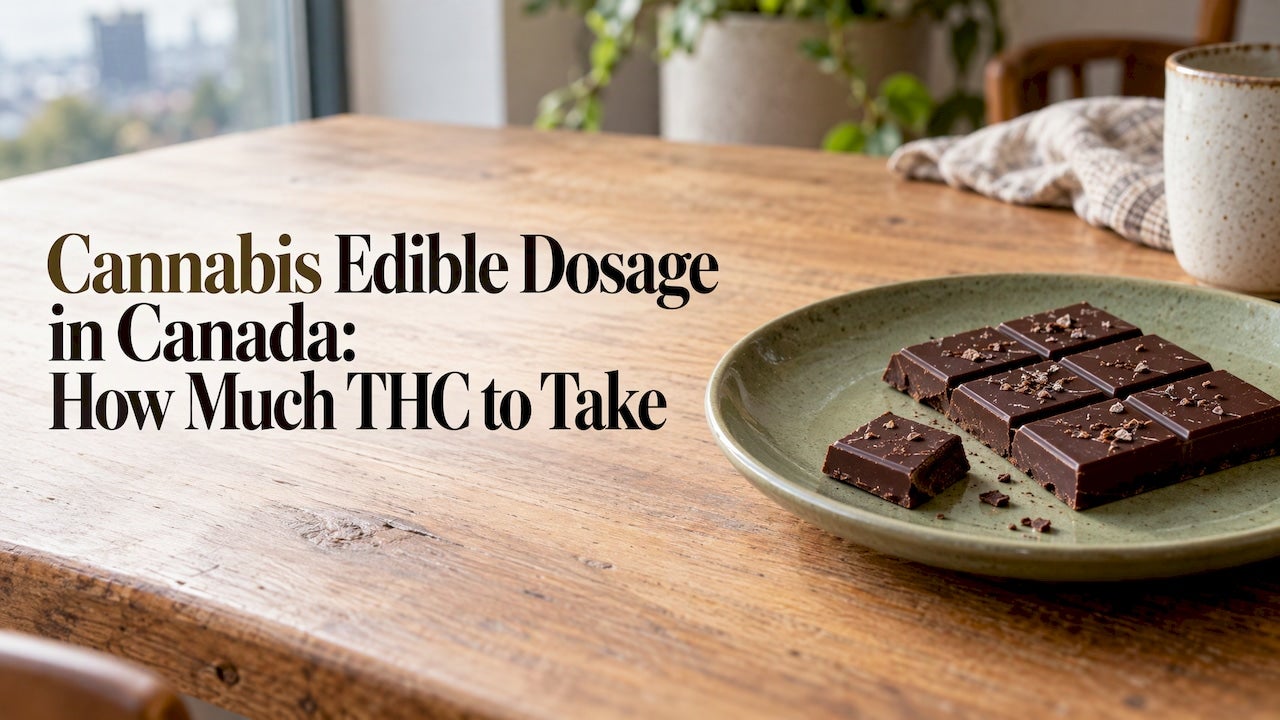
Chocolate. Chocolate bars and squares are divided into pieces, so the same label math applies: THC per unit, times the number of pieces. Eat by the piece rather than by feel, and stop at your planned dose. Chocolate is easy to keep eating, so portion out your dose before you start. Our page on cannabis-infused chocolate treats goes through the format in more detail.
Homemade edibles. A recipe is not a labelled product, so you have no per-unit number to rely on. For a first edible, a labelled product is the easier way to know exactly what you are taking.
If you have taken too much
The feelings of too much THC, such as anxiety, a racing heart or panic, are unpleasant but pass with time. Stay somewhere calm and safe, sit or lie down, and remember that the effects will wear off. Do not take more, and do not drive.
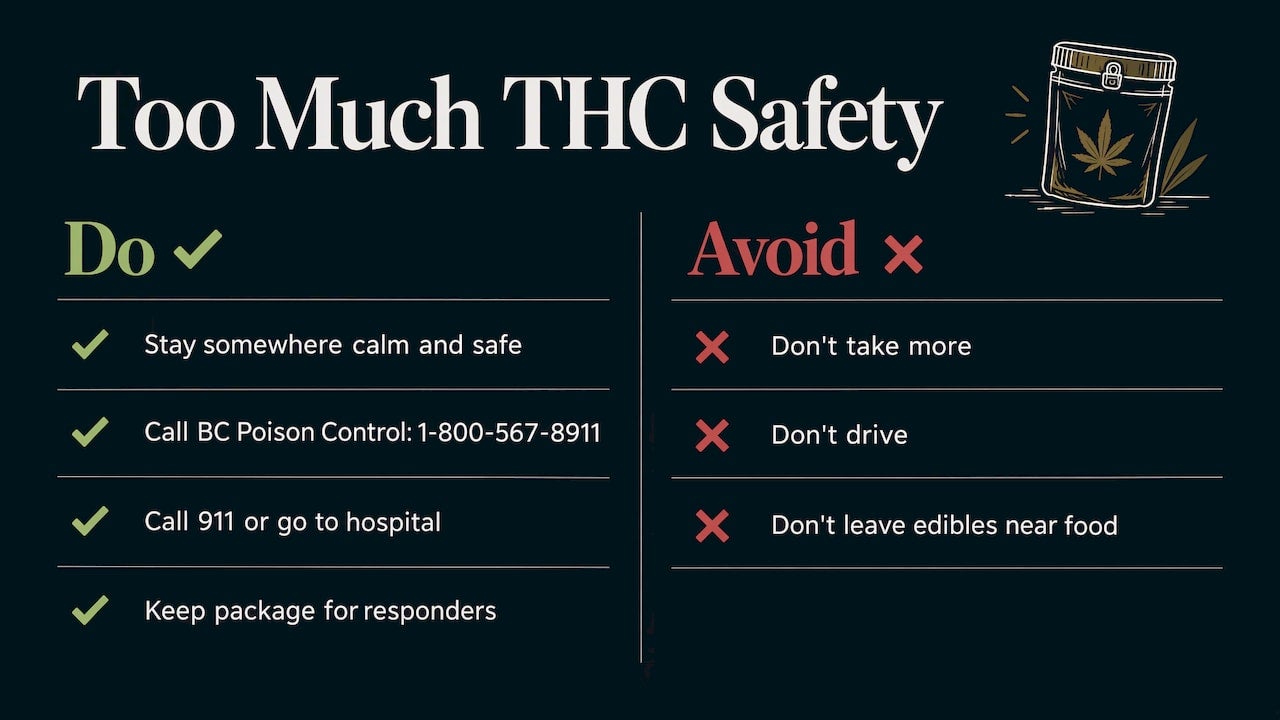
If you or someone else has accidentally consumed cannabis, or has consumed too much and is not well, the BC fact sheet advises seeking help right away from the BC Poison Control Centre at 1 800-567-8911 (or 604 682-5050), calling 911, or going to your local hospital emergency department. Keep the package so you can tell responders what and how much was eaten.
Store edibles safely. The CCMOH advises keeping cannabis in clearly labelled containers or its original child-resistant packaging, away from food and out of reach of children and pets. Edibles look like ordinary candy, so this matters in any home with kids.
Our view on edible dosing
We think the best edible experience is the one where nothing surprising happens. Most of the trouble comes from one thing: the wait. A gummy that has not yet kicked in feels like a gummy that did nothing, and that is when people reach for a second one.
That is why we put education next to selection. When you order from us, we want you to know what “per unit” means, how to count a package and how long to wait before deciding anything. Our site is built so that new and experienced users can find the right product without guessing, and our support team is there for questions about what you are choosing.
For us, a good dose is a small one that you chose on purpose. Start at 2.5 mg, keep notes, and build from there. Experienced users can do the same with premium products and will find the process quicker, because they already know their numbers.
the author
Where to find labelled edibles
Burnaby Buds is an online dispensary for Canadian residents, with same-day delivery and customer support. Our edibles range includes gummies and chocolates, alongside flower, concentrates, vape pens, CBD products and more. Browse the full edibles category to compare pieces and per-unit THC, or see everything we carry on our product categories page.

If you are new to edibles, read the label on the product page before you add to your cart, and pick the per-unit figure that matches your starting dose.
FAQ
How much THC should a beginner take in an edible?
Health Canada and the Council of Chief Medical Officers of Health both advise 2.5 mg of THC or less to start. Wait at least two hours before considering a second 2.5 mg dose, since full effects can take up to 4 hours.
How much THC is in an edible in Canada?
Licensed edibles contain no more than 10 mg of THC per package, and no single unit can exceed 10 mg. The label shows total THC per unit, so multiply by the number of pieces to find the package total. A 4-piece package at 2.5 mg per unit holds 10 mg.
How long do edibles last?
Effects start in 30 minutes to 2 hours and can take up to 4 hours to peak. Intoxicating effects can last up to 12 hours, and some residual effects up to 24 hours, according to the BC government fact sheet. Plan your day and do not drive.
Are there high-THC edibles in Canada?
Not above the legal limit. Edibles are capped at 10 mg of THC per package. Products with much more THC are classed as extracts, which follow separate rules and are not meant to be eaten like food.
What should I do if an edible is too strong?
Stay calm, stay somewhere safe and do not take more. If you feel unwell, call the BC Poison Control Centre at 1 800-567-8911 or 604 682-5050, call 911, or go to a hospital emergency department.
Sources
- Cannabis: lower your risks, Health Canada
- CCMOH statement on cannabis extracts, edibles and topical products
- How to read and understand a cannabis product label, Health Canada
- Edible Cannabis: Always Read the Label, CCSA
- Cannabis health warning messages, Health Canada
- Health effects of cannabis on adults over 55, Health Canada
- Cannabis Regulations (SOR-2018-144)
- Guide on composition requirements for cannabis products, Health Canada
- Health Canada Cannabis Regulations 2025 overview
- Classification of ingestible cannabis products, Health Canada
- Extracts and topicals cannabis, Government of Nova Scotia