
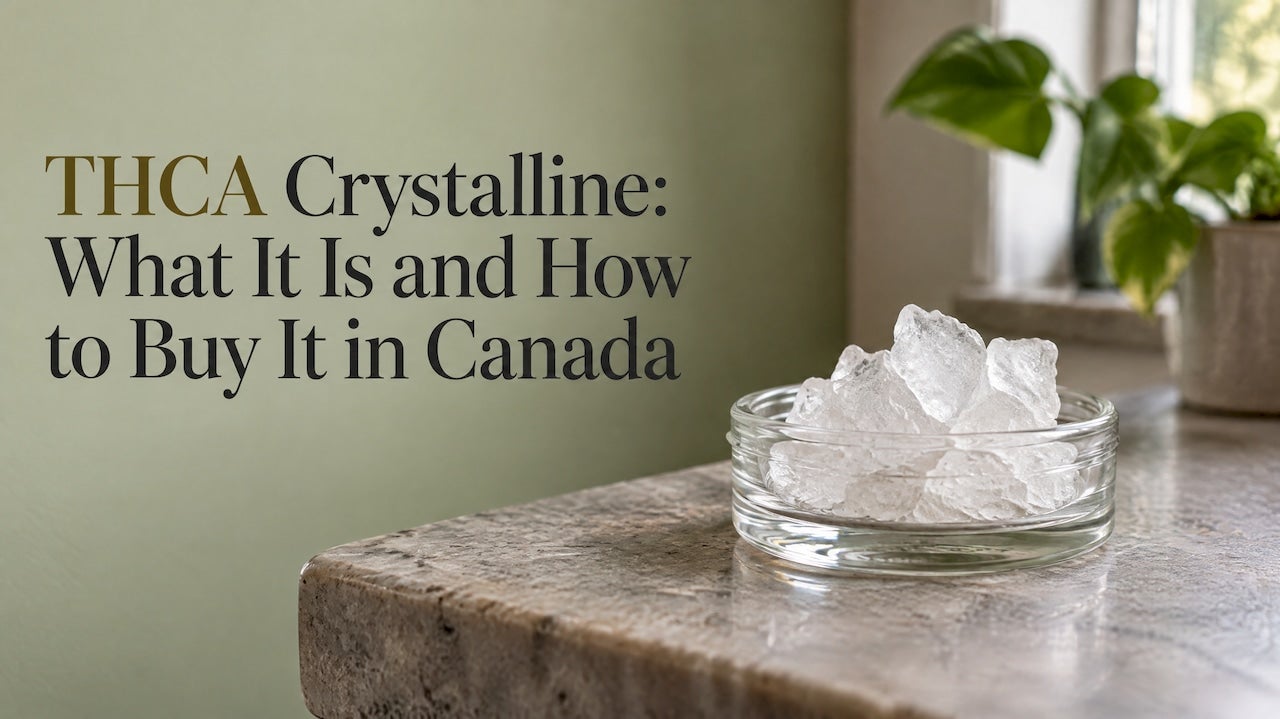
THCA crystalline is a cannabis concentrate made of THCA (tetrahydrocannabinolic acid) that has been grown into solid crystals, usually sold as “THCA diamonds” or as a crystalline powder. It is among the most concentrated cannabis products you can buy, and it is not intoxicating until it is heated, which is what turns THCA into THC. If you are shopping for it in Canada, three things matter: the lab report for the exact batch, a very small starting amount, and a supplier that ships legal, tested product to your door. Our concentrates category is where we list ours, including Social THCA Diamonds (1g).
TL;DR
-
THCA crystalline is a solid, crystal-form concentrate of THCA. “Diamonds” are the most common retail version, and “diamonds and sauce” pairs the crystals with a terpene-rich liquid.
-
A lab result of about 99% THCA does not mean 99% THC. After heating, the usable THC works out to roughly 87% of that figure, because a part of the molecule is lost as gas.
-
It is potent. Start with a fraction of what you would use of flower, wait for the full effect, and never drive after using it.
Table of Contents
What THCA crystalline actually is
Cannabis flower contains very little THC as it grows. Most of the cannabinoid is THCA, its acidic precursor. THCA does not produce the high in its raw form. Heat removes a carbon group in a step called decarboxylation, and that creates delta-9-THC, the compound responsible for intoxication. Health Canada describes delta-9-THC as the compound responsible for the way the brain and body respond to cannabis, including the high.
When THCA is concentrated enough, it stops staying dissolved in the extract and falls out as solid crystals. A peer-reviewed clinical framework from Canadian researchers describes isolates as cannabinoids in crystalline form or powder with other plant material removed, at close to 100% potency. The same paper explains that the brittleness of shatter comes from THCA crystallizing inside the extract, at up to 90% potency.
So “THCA crystalline” is a family of products rather than one item:
| Form | What it looks like | Typical use |
|---|---|---|
| THCA diamonds | Clear to white or pale yellow crystal chunks | Dabbing, or sprinkled on flower |
| Crystalline powder (isolate) | Fine white or off-white powder | Dabbing, or added to joints and bowls |
| Diamonds and sauce | Crystals sitting in a liquid, terpene-rich fraction | Dabbing, with more flavour |
| Shatter | Glass-like sheets with partial crystallization | Dabbing |
The main difference between diamonds and the other concentrates is purity and texture. Shatter, live resin and distillate all keep more of the extract’s other components or are processed differently. If you want to understand the neighbours, our guides to cannabis distillate and live resin cover how each is made and used.
How crystals are made
Diamonds are not harvested from the plant like a bud. They are a processed concentrate. A producer extracts cannabinoids and terpenes, then lets the extract separate. As Cannabis Now explains, almost every concentrate contains both terpenes and cannabinoids, which makes it prone to nucleation, the first step of crystal growth. “Diamond mining” or “jar tech” simply gives that natural separation time, so large crystals can form.
The result is usually two layers: solid THCA crystals and a liquid sauce full of terpenes, the aromatic compounds that give strains their smell and flavour. Some products are sold as clean crystals, others as crystals in sauce, and others as milled powder.
Colour is a rough clue, not a guarantee. Clean THCA crystals tend to look colourless or white. Slight tints can come from oxidation or leftover plant compounds, so use the lab report for purity rather than appearance.
Reading the numbers: potency and your COA
This is where most buyers get confused. A diamond product may list 98% or 99% THCA. That does not mean it delivers 99% THC.
When THCA converts to THC, the molecule loses mass. Labs commonly apply a factor of about 0.877, so 99% THCA works out to roughly 86.8% total THC after heating. Canada writes this idea directly into its rules. The Cannabis Regulations define the “potential to convert THCA into THC” as the maximum THC you would get if all the THCA converted. Health Canada’s guidance on labelling says that labels must show THC and CBD content including that potential conversion, and that each lot must be tested.
A quick worked example, with a made-up 1 g diamond tested at 99% THCA:
-
1 g at 99% THCA holds about 990 mg of THCA.
-
Multiply by about 0.877 and you get roughly 868 mg of THC once fully heated.
-
A tiny crystal of about 0.01 g, a tenth of a percent of a gram’s worth, would carry on the order of 8 to 9 mg of THC.
That last number is why small portions matter. A standard legal edible in Canada is capped at 10 mg of THC per unit, so a speck of crystal can equal a full edible.
Do not compare a THCA figure against a total THC figure as if they were the same measure. They are two different calculations, and different lab methods can also give different-looking numbers for the same product.
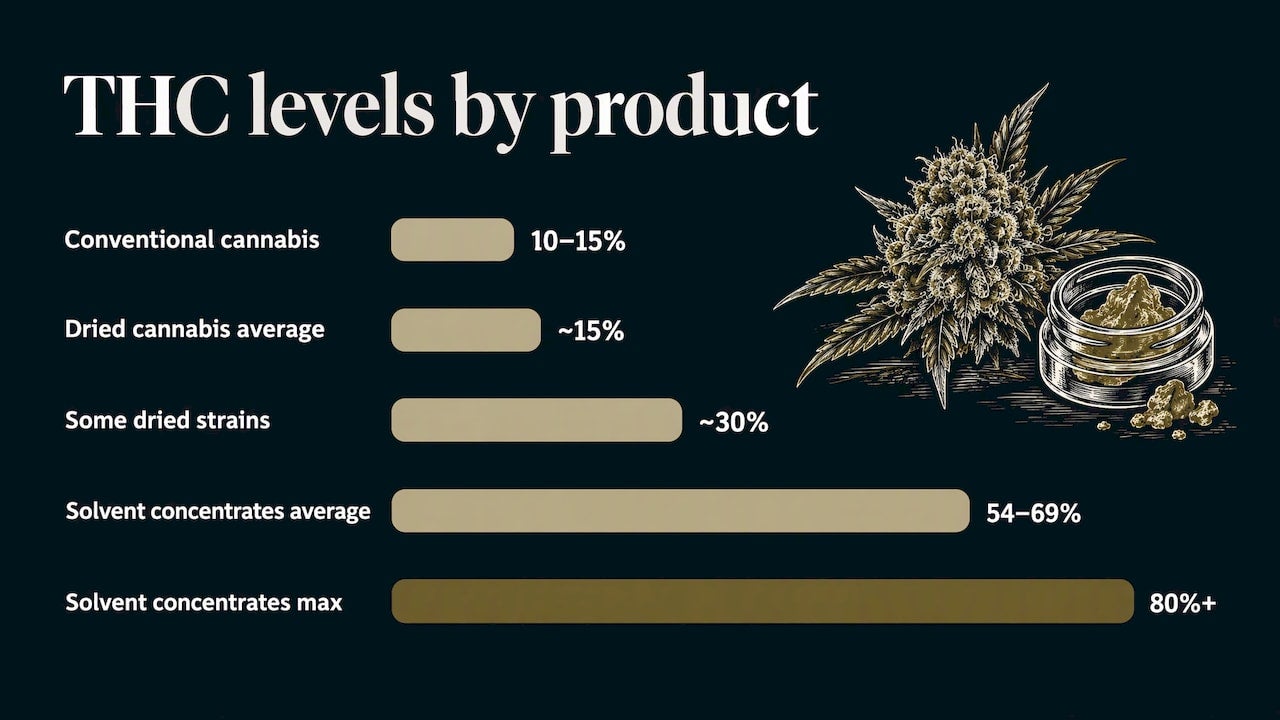
Purity is not guaranteed by a product name either. Labs can make crystals above 99%, but a retail product can be crystals plus terpene sauce, so the lot’s report is the real indicator. A 2021 research review also notes that solvent-based concentrates average 54 to 69% THC and can reach 80% or more, compared with 10 to 15% in conventional cannabis. Health Canada notes that dried cannabis averages around 15% THC today, with some strains near 30%. Crystalline products sit far above both.
Why the effects can feel different from flower
Two things drive the difference.
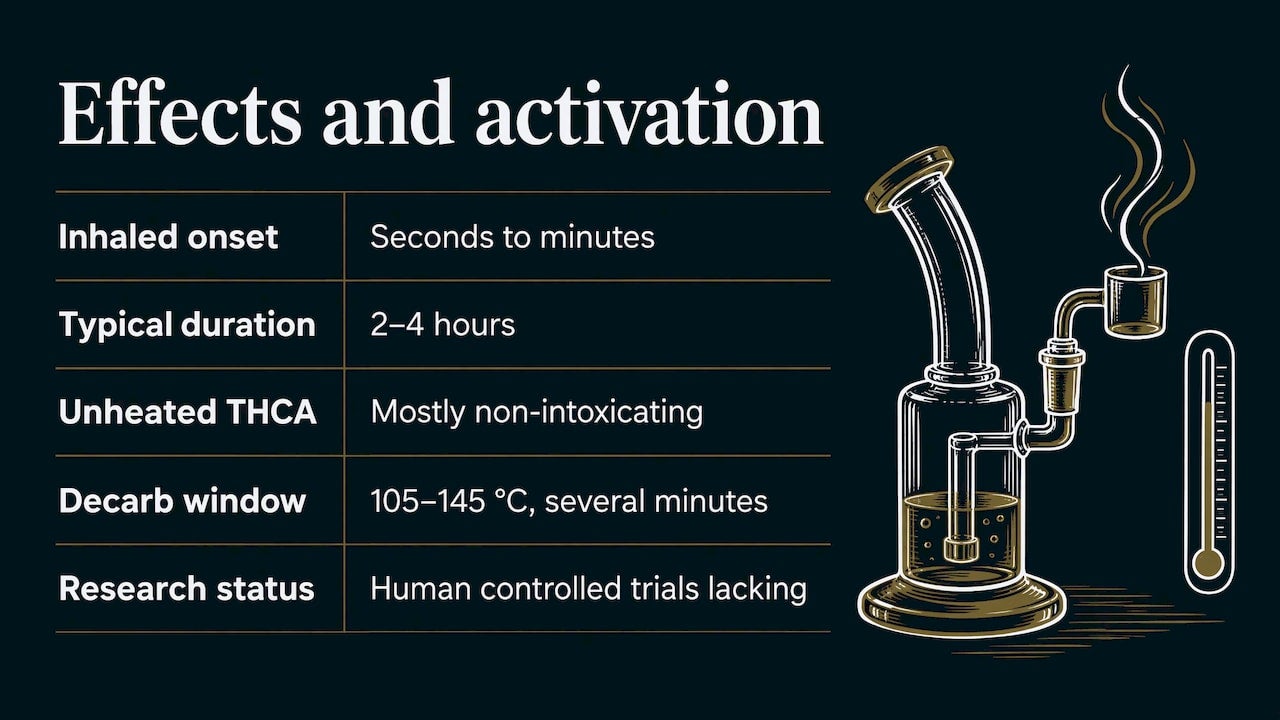
First, the dose arrives fast. Inhaled cannabis acts within seconds to minutes and typically lasts two to four hours, according to Health Canada’s consumer information. A concentrate delivers a large amount of THC in one breath. A researcher’s review of dabbing notes that delivering a high concentration at once raises the risk of dependence and of stronger adverse effects compared with traditional use.
Second, how you use it changes what you get. Unheated THCA is mostly non-intoxicating. A 2026 review of acidic cannabinoids reports that THCA is not intoxicating like THC, mainly when it is not heated, and that its best decarboxylation window is about 105 to 145 °C over several minutes. That is why “THCA flower” and diamonds are inactive in the jar and strongly active once a flame, rig or vaporizer heats them. If you want the plain-language difference between the compounds, our page on the difference between THC and CBD is a good starting point.
The same review is clear that research on THCA is early: human controlled trials are lacking. So treat it as a product for adult use and do not expect health outcomes from it.
How people use it, and how much
Crystalline THCA is most often used in one of three ways:
-
Dabbing: a small piece placed on a heated surface of a dab rig and inhaled.
-
Sprinkled on flower: crystals or powder added to a bowl or a joint, which raises the strength of what you smoke.
-
Vaporizing: a vaporizer made for concentrates, at a controlled temperature.
For a first session, the standard harm-reduction approach is “start low and go slow.” CAMH, Canada’s Centre for Addiction and Mental Health, suggests starting with 1 to 2.5 mg of THC and increasing slowly, with a daily maximum of 40 mg in its clinical guidance. Their tips also note that inhaled products have bioavailability of 15 to 50%, compared with 6 to 20% for oral products. In plain terms, more of the THC reaches you when you inhale.
A practical routine for a newer user:
-
Start with a speck smaller than a grain of rice, which is the common guidance in consumer guides.
-
Wait at least 15 to 20 minutes before taking any more, since the full effect of inhaled cannabis can take a few minutes to build.
-
Keep a log of the amount, the product and how you felt, so you can find your level.
-
Do not mix with alcohol or other drugs, and never drive.
The World Health Organization’s drug dependence committee notes that people who switch to a product with higher THC than their usual tend to take more, and end up with greater overall exposure. If you normally smoke flower, a crystalline concentrate deserves a fresh start, not your usual amount.
If crystals feel like too much, a milder path is low-THC strains, which we explain how to choose.
Safety: who should avoid it and what to do if it goes wrong
Health Canada lists the immediate effects of cannabis as euphoria, dizziness, a faster heart rate, anxiety, panic, paranoia, impaired memory and attention, dry mouth, red eyes and drowsiness, and says serious effects can include psychotic symptoms. Its consumer information page also states that harmful effects may be greater when THC strength is higher.
Use extra caution, or speak to a doctor first, if you:
-
are pregnant or breastfeeding;
-
have a heart condition, since THC raises heart rate;
-
have a personal or family history of psychosis;
-
take prescription medication that interacts with cannabis, in which case your pharmacist or doctor can check.
If you take too much and feel unwell, Health Canada says to call 1-844-POISON-X (1-800-463-5060 in Quebec), call 9-1-1, or go to the nearest hospital. Sit down, drink water and stay with someone you trust while the effects pass.
Keep all cannabis locked away from children and pets. Concentrates are not suitable for anyone under the legal age in your province.
How to choose a crystalline product online
When you shop, run through this list:
-
Find the exact product type. Diamonds, diamonds and sauce, powder and shatter behave differently. Sauce adds flavour and a softer, wetter texture.
-
Check the lot’s lab report. Match the batch number and read both THCA and total THC.
-
Do the conversion yourself. Multiply the THCA percentage by about 0.877 to estimate what you will get after heating.
-
Match the amount to your tolerance. A 1 g jar of diamonds holds hundreds of milligrams of THC, which lasts many sessions at a small portion.
-
Plan your gear. Crystals need a rig, a vaporizer or a flower base to sprinkle on, so check you have what you need.
-
Confirm delivery. Concentrates should arrive discreetly, in sealed packaging, with age verification at the door.
People also ask where to find the strongest option. Potency is not the only goal. A first-timer is better served by a lower-strength product they enjoy than by the highest percentage on the page, and experienced users will care more about flavour, clarity and consistency.
Where to get it
We are an online cannabis dispensary for adult residents of Canada, and we offer flower, edibles, concentrates, vape pens and cartridges, CBD, topicals, accessories and more, with same-day delivery and customer support. Our concentrates range includes Social THCA Diamonds (1g), and the whole range sits in the concentrates category. If you are not sure which format fits, our support team can help you choose, and our guides explain the products before you buy. You can also browse every category on the shop page.
New to concentrates? Start in the glossary of cannabis terms, then pick a small format and the lowest dose that works for you.
Our view on THCA crystalline
We see THCA crystalline as a product for people who already know what they like and want precision. The appeal is clear: a clean, flavourful concentrate that is inert until you heat it, and a lab report that tells you what is inside.
That is also why we put education first. A percentage on a jar is only useful once you can read it, so we encourage every customer to learn the THCA-to-THC conversion, to look at the batch’s lab results and to begin with the smallest portion.
Our aim is to make buying simple. We offer a wide range of concentrates, fast delivery across Canada and customer support for first-time and experienced users alike, so you can choose a product that fits your experience and your budget.
the author
FAQ
Is THCA crystalline the same as THC diamonds?
Mostly, yes. “THC diamonds” is retail shorthand, while “THCA diamonds” is more accurate, because the crystals are THCA until they are heated. Crystalline can also mean powder, which is the same compound in finer form.
Will THCA crystalline get me high?
Not in its raw form. THCA is mainly non-intoxicating until heat converts it to THC. Once you dab, vaporize or smoke it, the effects are those of THC, and at a high concentration they can be strong.
How much should a beginner use?
Very little. CAMH’s clinical guidance starts at 1 to 2.5 mg of THC and raises the amount slowly. In practice that means a crumb of crystal much smaller than a grain of rice, then a wait before any more.
Is THCA crystalline legal in Canada?
Canadian rules count the THCA that can convert to THC, so crystals are regulated as a cannabis concentrate or extract. Products must follow the federal limits, such as 1,000 mg of THC per container for extracts, and you must be of legal age in your province.
How do I know what is in my batch?
Read the certificate of analysis for the lot number on your package. It lists THCA, total THC and contaminant tests, which is more reliable than a name like “ultra pure.”
Sources
-
Health Canada: Guidance on cannabis products with intoxicating cannabinoids
-
Health Canada: Displaying THC and CBD content on dried cannabis products
-
Therapeutic potential of acidic cannabinoids: an update, PMC
-
WHO Expert Committee on Drug Dependence: extracts and tinctures