

If you want cannabis for a creative session or a social evening, choose by the numbers on the label, not by a strain’s reputation. Look at the THC and CBD content, pick a form you can dose precisely, and start low. Strain names such as Jack Herer or Blue Dream are a starting point for browsing. They don’t guarantee an effect. At Burnaby Buds you can shop flower, edibles, vapes and CBD products by category and get same-day delivery in Canada, so the choice stays practical.
TL;DR
- Indica, sativa and hybrid labels are not reliable predictors of how a product feels. The measured THC and CBD content, the product form and your dose tell you more.
- For a creative or social setting, a low-to-moderate THC product with some CBD is the steadier starting point. Health Canada suggests less than 10% THC with equal or higher CBD for new consumers.
- Higher doses can bring anxiety, paranoia and a foggy head, which is the opposite of what you want at an easel, a keyboard or a party.
- Start with a small amount, wait, and don’t drive for at least 6 hours after use.
- Adults only: the federal minimum age is 18, and British Columbia sets it at 19.
Table of Contents
- What people actually mean by “creative weed”
- Do strain names and indica/sativa labels predict creativity?
- How to read a label for a clear, creative head space
- Picking the form: flower, vape, edible or concentrate
- Why more is not better for creative work
- Weed for socializing: what to expect and how to keep it easy
- Safety guidance Canadian adults should follow
- Canadian rules to know before you order
- A simple plan for your first creative or social session
- Our view: choose by the label, shop with a guide
- Ready to shop?
- FAQ
- Sources
What people actually mean by “creative weed”
When someone searches for weed for creativity, they usually want one of three things. Some want a light, upbeat head space for writing, music, drawing or brainstorming. Some want to loosen up and enjoy a creative activity, like a painting night or a jam session. Others want a relaxed social mood for a get-together.
All three come down to the same practical question: how do you get a gentle effect that doesn’t tip into sleepy, scattered or anxious? That is a question about dose, potency and product type, and it is where most of the useful decisions sit.
A few things shape the experience far more than the strain name:
- How much THC you take. THC (tetrahydrocannabinol) is the compound responsible for the high.
- Whether CBD is present. CBD (cannabidiol) does not cause a high and is often paired with THC for a more balanced feel. If you want the basics, our guide to the difference between THC and CBD covers it.
- How you take it. Inhaled effects arrive within minutes. Edibles take much longer and last longer.
- Your own tolerance, mood and setting. The same product feels different on a calm afternoon alone than at a crowded party.
Do strain names and indica/sativa labels predict creativity?
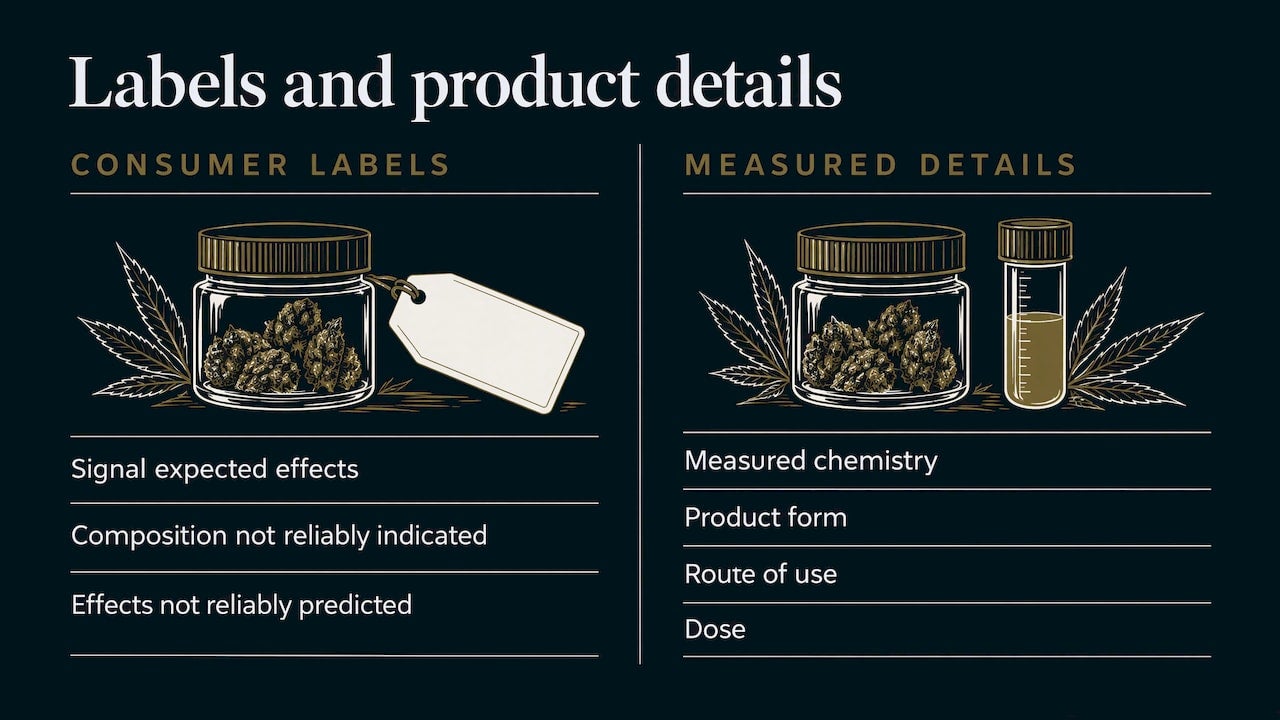
They are a rough guide at best. A 2026 academic review of consumer-facing indica, sativa and hybrid labels found that they signal expected effects but are not reliable guides to composition or effects. The review points to measured chemistry, product form, route of use and dose as more defensible ways to describe a product.
Genetics research points the same way. A study summarized by The Conversation found that strains labelled indica were often just as closely related to sativa-labelled strains as to other indicas, and that a name like OG Kush did not reliably indicate genetic identity or chemical profile.
So why do the same names keep appearing on creativity lists? Names such as Jack Herer, Durban Poison, Blue Dream, Sour Diesel and Strawberry Cough are popular with people who describe an energetic, head-focused effect, and they are widely stocked. That makes them a sensible shortlist to browse, but treat them as a starting point. Two jars with the same name from different producers can differ in THC level and aroma, which is why the label figures matter more than the name.
If you want the longer explanation of how the categories are used in shops, see our overview of sativa, indica and hybrid.
How to read a label for a clear, creative head space
Every legal product in Canada carries a label with its THC and CBD content. Use it the way you would use a nutrition panel.
THC percentage
Health Canada’s consumer guidance says that to minimize risks, or if you are a new consumer, you should look for a product with less than 10% THC and equal or higher levels of CBD. It advises caution with products between 10% and 20% THC, and the most caution with products above 20% THC, such as shatter, wax or distillates.
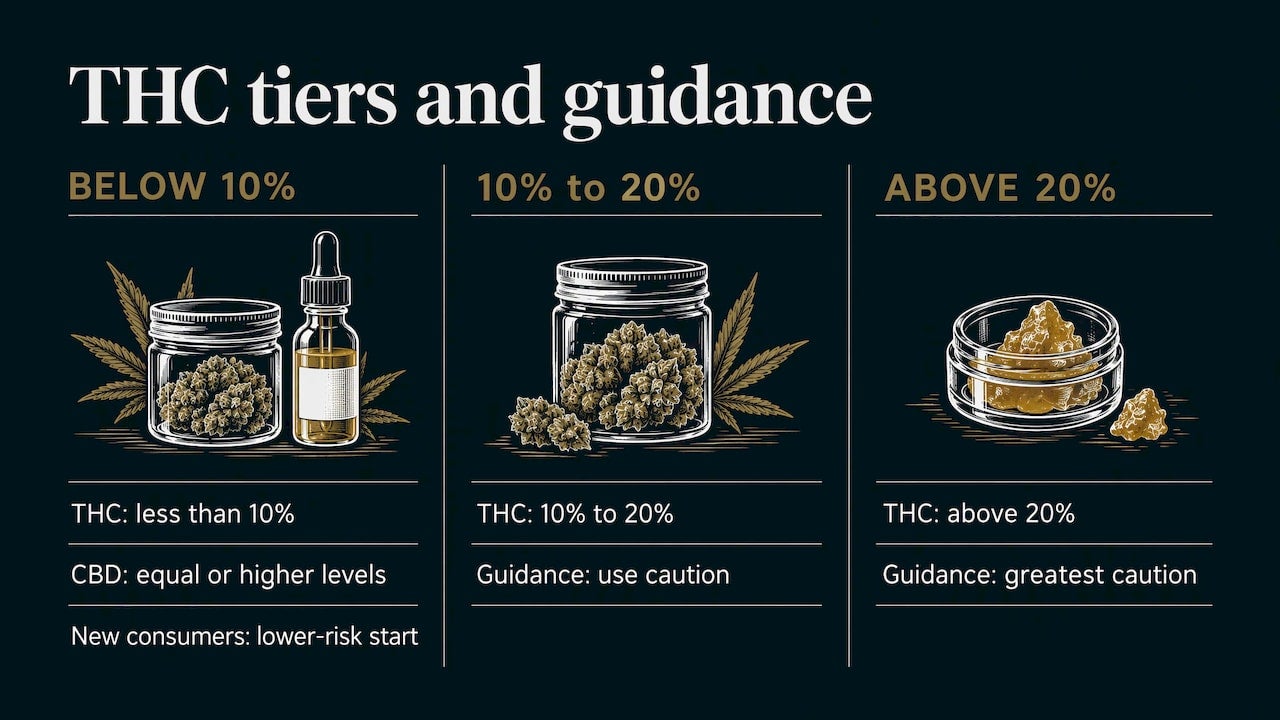
For a creative session, that means the mid and upper tiers are not automatically the better pick. A stronger product doesn’t make you more inspired. It makes the effect bigger and harder to steer.
The THC to CBD ratio
Canada’s Lower-Risk Cannabis Use Guidelines recommend low-THC products with high CBD-to-THC ratios. A 2024 review notes that dose and the THC:CBD ratio are among the factors that shape the acute effects of cannabinoids on thinking and mood. In practice, a product with both THC and CBD is a gentler place to start for a daytime project. Our page on low THC strains walks through choosing a mild option in Canada.
CBD flower sold with its THC level and cultivation details listed is another way to see what the numbers look like. CBD flower with listed THC levels shows how producers present the ratio, which is handy practice for reading any label.
Terpenes and aroma
Terpenes are the aromatic compounds that give cannabis its citrus, pine, pepper or fuel smell. Reviews of the evidence don’t give a firm basis for promising a particular effect from a terpene, so use them as a guide to what you enjoy smelling and tasting rather than a prediction. If a jar smells bright and fresh to you and you like it, that is a fair reason to choose it.
Picking the form: flower, vape, edible or concentrate
The form decides how fast the effect starts, how long it lasts and how easy it is to measure a small amount.
| Form | Onset | Best for | Watch for |
|---|---|---|---|
| Flower or pre-roll | Minutes when inhaled | People who like to adjust a little at a time | Smoking is a combusted form, which the lower-risk guidelines advise avoiding |
| Vape pen or cartridge | Minutes | Quick, discreet use with easy small puffs | Concentrated oils can be strong, so check the THC figure |
| Edibles and gummies | Slow, often an hour or more | Evening sessions with a known, measured dose per piece | Taking more because nothing seems to happen yet |
| Concentrates | Fast and intense | Experienced users with high tolerance | Products above 20% THC call for the most caution |
The lower-risk guidelines recommend avoiding smoking combusted cannabis, so if you inhale, a vaporizer is the lower-harm route among inhaled options. You can browse vape pens and refills and edibles by category. If a measured dose per piece appeals to you, our piece on why gummies are a popular edible explains the format.
Why more is not better for creative work
The research on cannabis and creative thinking is worth knowing as dose guidance. A 2014 study found that 22 mg of vaporized THC impaired divergent thinking in regular users, which is the kind of thinking used to come up with many different ideas, while low-potency cannabis had no impact on it. That study is a reminder that dose is the variable you control, and that a big dose is a poor fit for a task that needs you to stay clear and organized.
There is also the matter of how things feel versus how they turn out. Researchers have suggested that cannabis can bring a cheerful mood that makes people rate their own work and ideas more favorably. Enjoying the process is a perfectly good reason to use cannabis. If you are working toward something you’ll show other people, it helps to review your work the next day with a clear head.
Other things that matter in a creative session:
- Know what you want to make. Decide on the session’s aim before you start, so you spend the effect on the work rather than on deciding what to do.
- Keep tools and notes close. Record ideas as they arise, whether on paper or a voice memo.
- Pace yourself. Wait before adding more. With inhaled forms that means at least several minutes, and with edibles it means a lot longer.
- Hydrate and eat. A snack and water are the cheapest comfort upgrade you have.
Weed for socializing: what to expect and how to keep it easy
People often ask about social strains, so here is the honest picture. A 2024 review found that cannabinoids can produce euphoria, relaxation and increased sociability, but can also trigger anxiety, panic and negative mood, and acute use can impair decision-making and inhibition.
The social picture is mixed. A 2018 review concluded that cannabis does not robustly increase social behavior, with talking and interaction going up for some people and down for others. In that review, a low oral THC dose of 7.5 mg slightly decreased distress during a social stress task, while a higher 15 mg dose increased tension and stress.
CAMH, Canada’s largest mental health teaching hospital, notes that at lower doses cannabis can slightly change perception, with people often saying music sounds better and colours look brighter. Stronger THC doses can intensify the effects you want and also produce anxiety, paranoia and panic.
A few ways to keep a social session pleasant:
- Choose a low dose and stick with it. Everyone’s tolerance differs, so don’t match the person next to you.
- Prefer products with some CBD. A balanced ratio is the lower-risk option the guidelines point to.
- Avoid mixing with lots of alcohol. Stacking substances makes it harder to judge how you feel.
- Be with people you trust, in a place you know. Familiar surroundings help the mood stay easy.
- Have a plan to get home without driving.
Safety guidance Canadian adults should follow
Some points aren’t about which product is best. They are about staying well, and they hold whatever you buy.
- Occasional use. The lower-risk guidelines recommend occasional use, such as one day a week or less, and avoiding frequent or intensive use.
- No driving. Wait at least 6 hours after use before driving, and longer if you took an edible or a large dose.
- Avoid synthetic cannabis. Stick to regulated products with a full label.
- Family or personal history. The guidelines advise avoiding cannabis if you have a personal or family history of psychosis or substance use disorders. If that applies to you, speak to your doctor before using it.
- Paranoia and vulnerability. Research using intravenous THC in people prone to paranoid thinking showed that THC increased paranoia and negative mood. If you notice anxious or suspicious thoughts after using cannabis, take it as a sign to stop and talk with your doctor.
- Age. Early initiation, particularly before 16, is one of the risks named in the comprehensive lower-risk guidelines.
If you want to understand how cannabis can affect recall, our article on cannabis and memory is a good next read before a project that needs you to remember details.
Canadian rules to know before you order
Non-medical cannabis became legal for adults in Canada on October 17, 2018 under the Cannabis Act. Under federal rules, adults can possess up to 30 grams of dried cannabis in public, share up to 30 grams with other adults, and grow up to 4 plants per residence from legal seeds or seedlings. The federal minimum age to purchase is 18, or higher where a province or territory sets it.
In British Columbia, where Burnaby, Vancouver, Surrey and Coquitlam are, only adults aged 19 or older may purchase, possess and consume non-medical cannabis. It is also an offence to supply cannabis to anyone under 19, including buying it on their behalf. Rules differ by province, so check yours before you order.
A simple plan for your first creative or social session
- Choose your goal. Writing, painting, a jam session or a night with friends each suits a slightly different amount.
- Pick a gentle product. Look for lower THC with CBD present, and read the label figures.
- Pick a form you can measure. A small puff of a vape or a low-dose gummy is easier to control than a strong concentrate.
- Take a small amount and wait. Give it time before you decide you need more.
- Set up the space. Notes, water, snacks, music, and a safe way home.
- Keep a short log. Write down the product, the amount and how you felt. After a few sessions you’ll know what suits you far better than any list of strains could tell you.
Our view: choose by the label, shop with a guide
Most people who ask us about creative or social strains are really asking how to feel good without losing the plot. We think the best answer is practical: read the THC and CBD figures, pick a form that lets you measure a small amount, and add more only when you know how you feel.
That is why our shop is organised by product type, and why we publish guides on low THC strains, the THC and CBD difference and how the strain categories are used. We want first-time buyers to feel confident and experienced users to find premium products without the guesswork.
Our online store offers flower, edibles, concentrates, vape pens, cartridges, pre-rolls and CBD products, with same-day delivery and personalized customer support. If you aren’t sure where to start, our educational guides are written to help you decide.
the author
Ready to shop?
If you’re ready to pick something up for your next creative or social session, Burnaby Buds carries flower, edibles, concentrates, vape pens and refills, and CBD products, with same-day delivery and customer support to help you choose. Browse all product categories, or go straight to cannabis flower.
FAQ
What is the best weed for creativity?
There isn’t a single best product, because indica and sativa labels are not reliable guides to effects. A sensible pick is a lower-THC product with some CBD in a form you can dose in small steps. Popular names to browse include Jack Herer, Durban Poison and Blue Dream, but go by the label figures.
Are there social weed strains?
Strain names don’t reliably predict social effects either. Research shows that cannabis can increase sociability for some people and cause anxiety for others, depending on dose, setting and personal vulnerability. A low dose with CBD present, taken among people you trust, is the steadier approach.
How much THC should a beginner choose?
Health Canada suggests that new consumers look for products with less than 10% THC and equal or higher levels of CBD. Start with a small amount and give it time to take effect before taking more. Edibles take the longest to work, so patience matters most with them.
Can I drive after using cannabis?
Canada’s lower-risk guidelines advise not driving for at least 6 hours after use. Edibles and larger doses can last longer, so plan a ride home or stay put for the night.
Who should avoid cannabis?
The lower-risk guidelines advise avoiding it if you have a personal or family history of psychosis or substance use disorders. Anyone under the legal age in their province should not use it. If you are unsure whether it suits you, ask your doctor.
Sources
- Do consumer-facing Indica, Sativa and Hybrid labels reflect composition or effects? (2026)
- Indica and sativa labels are largely meaningless (The Conversation)
- What you need to know if you choose to consume cannabis (Health Canada)
- Canada’s Lower-Risk Cannabis Use Guidelines: An Evidence Brief (CAMH, 2019)
- Lower-Risk Cannabis Use Guidelines: A Comprehensive Update (2017)
- Acute cognitive and psychiatric effects of cannabinoids (2024)
- Cannabis and creativity: highly potent cannabis impairs divergent thinking (2014)
- Cannabis use does not increase actual creativity but biases evaluations (2022)
- Considering the context: Social factors in responses to drugs (2018)
- Cannabis (CAMH)
- How Cannabis Causes Paranoia (2014)
- Legalizing and strictly regulating cannabis (Health Canada)
- Age restrictions (BC Cannabis Stores)