News
Low THC Strains: How to Choose a Mild Strain in Canada
Nov
A low THC strain is, in practical terms, flower with about 10% THC or less, ideally with CBD at the same level or higher. Health Canada gives that same benchmark for new consumers: inhaled products under 10% THC with equal or higher CBD, or edibles with 2.5 mg of THC or less. This guide explains what that means on a label, which mild strains people ask for by name, how the effects differ from high-THC cannabis, and how to start so the first session is a pleasant one.
TL;DR
- Health Canada’s guidance for new consumers is inhaled products under 10% THC with equal or higher CBD, or edibles at 2.5 mg THC or less.
- Strains such as Harlequin, Cannatonic, ACDC, Pennywise and Ringo’s Gift are the names most often mentioned as mild, but every batch differs, so the label on your jar is what counts.
- Read Total THC and Total CBD on the front of the package, not the strain name or a marketing line.
- Start low and go slow: one or two puffs, then wait. Edibles can take up to 4 hours to show their full effect.
- Never drive or operate machinery after using cannabis, whatever the potency.
Table of Contents
- What counts as a low THC strain
- Mild strains people look for by name
- Low THC, high CBD, or both high?
- What low THC cannabis feels like
- How to read a Canadian cannabis label
- How to start: inhaled products and edibles
- Safer use, in plain terms
- Our perspective
- Shop mild options with same-day delivery
- FAQ
- Sources
What counts as a low THC strain
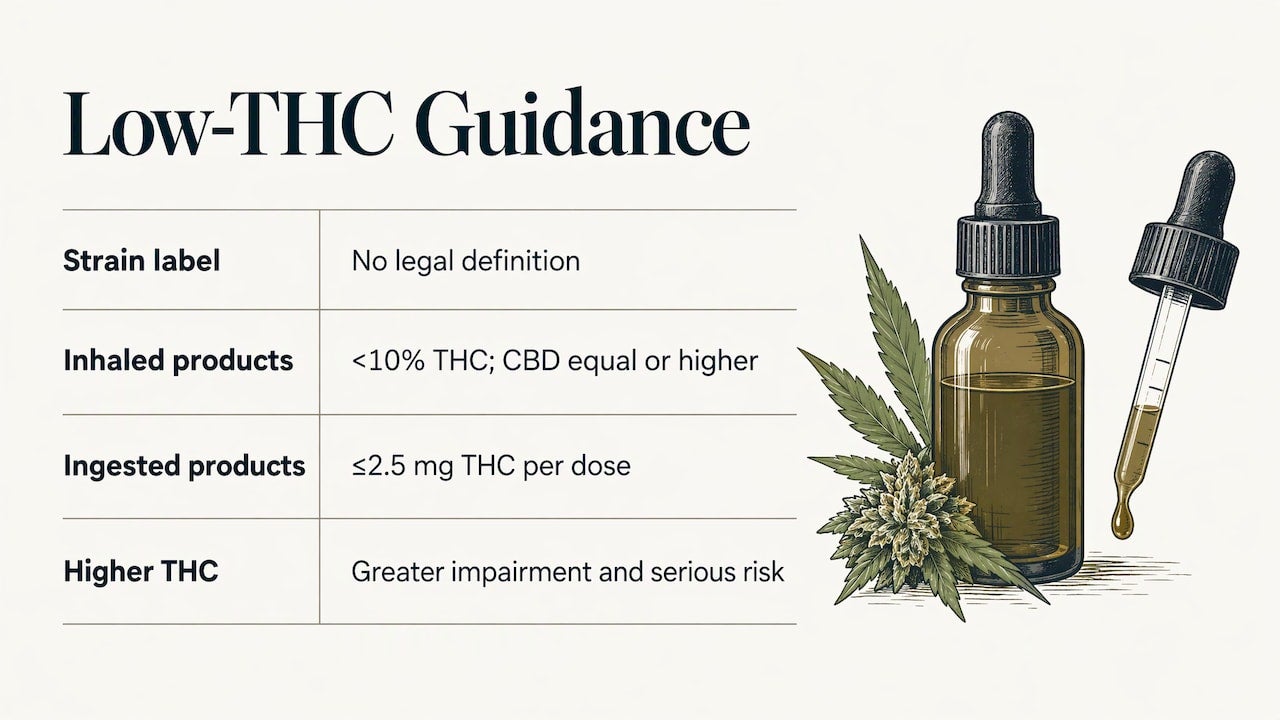
There is no legal definition of “low THC” for a strain. It is a working label that shoppers and budtenders use. The most useful anchor in Canada comes from Health Canada, which tells people who are new to cannabis, or who want to minimize risk, to look for inhaled products with less than 10% THC and equal or higher CBD. For ingested products the figure is 2.5 mg of THC or less per dose.
To put that in context, much of the dried flower on shelves today tests well above that line. That is why “mild” has become its own search: plenty of people want a relaxed, clear evening, not a heavy one. Youth-focused research from the University of Victoria’s CISUR centre notes that many users find lower-potency products enough for mood lift and stress relief, and that the pressure to chase high potency is misplaced.
The reason the number matters is simple. Health Canada states that higher levels of THC can cause greater impairment and raise the risk of serious adverse effects. Lower THC gives you more margin for error, which is exactly what a first-timer or an occasional user wants.
Percent THC versus milligrams of THC
Flower and pre-rolls are labelled by percentage of THC by weight. Edibles, capsules and beverages are labelled in milligrams per package or per serving. A 10% flower is not the same experience as a 10 mg gummy: smoke or vapour reaches you within minutes, while an edible is processed through your digestive system and liver. Treat the two scales separately and use the matching guidance for each, covered below.
Mild strains people look for by name
Strain names are a starting point, not a guarantee. Cultivators grow the same genetics under different conditions, and lab results vary from batch to batch. With that said, a short list of names comes up again and again when people look for gentle cannabis:
| Strain | Why it gets mentioned |
|---|---|
| Harlequin | A long-standing CBD-rich option, often described as clear-headed |
| Cannatonic | Known as a CBD-forward cross, often picked for a calm, easygoing feel |
| ACDC | Probably the best-known high-CBD, low-THC name, and a parent of several newer crosses |
| Pennywise | A balanced THC and CBD profile that appears on many beginner lists |
| Ringo’s Gift | An ACDC cross known for a smooth, clear-headed, harmonious reputation |
These are the names a reader will see in most beginner guides, so it helps to recognize them. What you will actually find in stock depends on the licensed producers behind each product, and many of them sell under their own cultivar names. Two practical consequences follow.
First, do not shop by name alone. A strain called by a mild-sounding name can still test well above 10% THC in a given harvest. Second, if the name you want is unavailable, you lose nothing: the same numbers on a different label give you the same kind of experience, and the numbers are what you are really buying.
If you want to understand where these genetics came from and why some lines lean CBD, our piece on landrace cannabis strains and their influence on BC bud is a good place to start.
Low THC, high CBD, or both high?
These are three different products, and shoppers often mix them up.
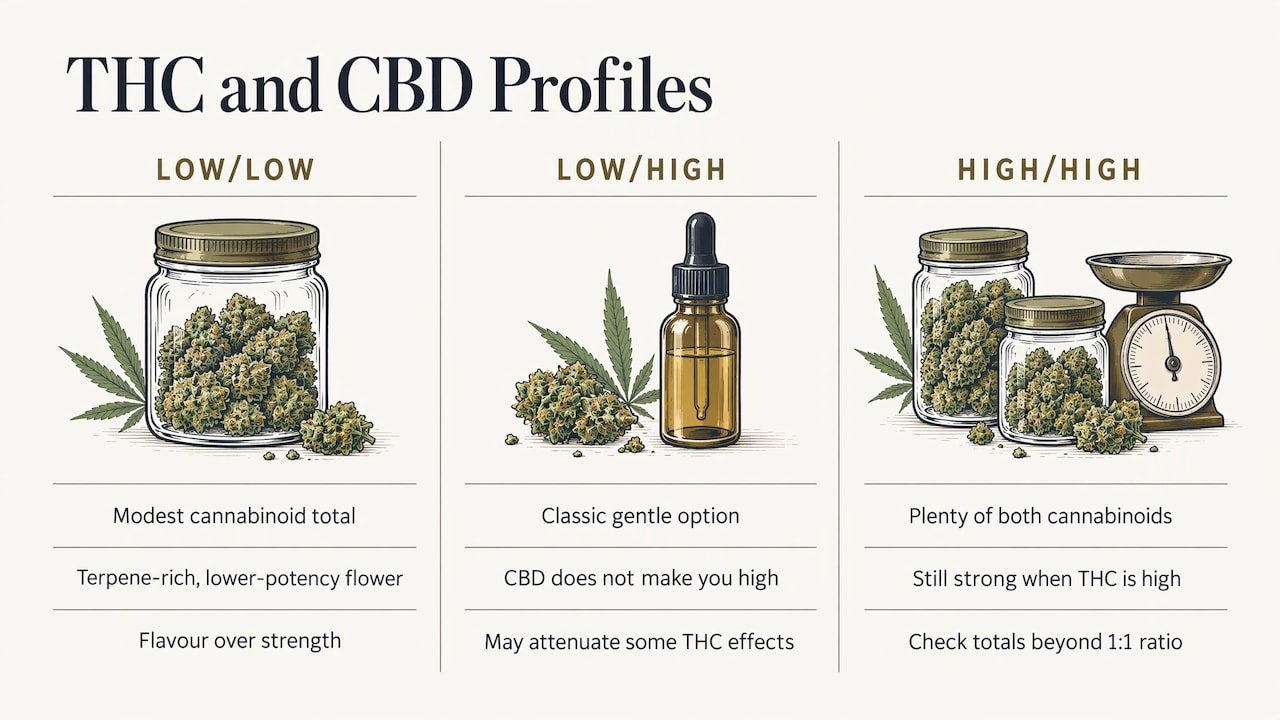
Low THC, low CBD. Mild in every sense. Some strains simply have a modest cannabinoid total and a lot of aroma. Terpene-rich, lower-potency flower is a growing niche for people who care about flavour more than strength.
Low THC, high CBD. This is the classic gentle option and the one Health Canada’s benchmark points toward. CBD does not make you feel high, and it may attenuate some effects of THC, with high CBD to THC ratios typically carrying less severe health risks.
High THC and high CBD. Possible, since THC and CBD are not opposites on a single scale. A product can carry plenty of both. It will still be strong, because the THC is high, so it does not belong in the “mild” category. When you see a balanced ratio, such as 1:1, check the totals as well as the ratio. A 1:1 product at 20% and 20% is a very different purchase from one at 8% and 8%.
For a plain-language breakdown of what each compound does, see our guide to the difference between THC and CBD.
What low THC cannabis feels like
Expect something subtler than high-potency flower, not nothing. Typical descriptions include light relaxation, a gentle mood lift, and a head that stays clear enough for conversation, cooking or a walk. Some people feel very little at first, which is normal at low doses and is no reason to double up right away.
Dose changes the picture in a way that surprises people. Cannabis compounds are described as having biphasic properties: small doses tend to stimulate, while large doses sedate, and “less is more” is often true. A small amount of a mild strain may feel lively and focused, while pushing the amount up can leave you drowsy.
Terpenes also shape the experience. Citrus-forward and pine-forward profiles are generally described as brighter, while earthy and musky ones as more settled. Treat this as a rough guide, because individual response varies with body, tolerance, setting and what you have eaten.
If you are choosing by time of day, our guides to cannabis strains for day-to-day use and strains for a restful night’s sleep pair well with this one.
How to read a Canadian cannabis label
Canada’s packaging rules make mild shopping easier than almost anywhere else, because the numbers you need are on the front. Health Canada’s label guide says Total THC and Total CBD must be displayed on the front of the package, expressed by weight, unit, total amount or activation, as applicable.
A quick checklist:
- Total THC. For flower or pre-rolls, aim for 10% or under if you are new.
- Total CBD. Equal to or higher than THC is the gentlest combination.
- Format. Flower and vapes show a percentage; edibles show milligrams per piece and per package.
- Excise stamp. It indicates a Health Canada licence holder, though some low-THC or prescription products do not need stamps.
- Harvest or packaged date. Fresher product usually smells and tastes better.
If a product page does not show Total THC and Total CBD, ask customer support before you order.
How to start: inhaled products and edibles
Flower, pre-rolls and vapes
The federal guidance is concrete: start with one or two puffs of a vape or joint at 10% THC or less, and remember it can take up to 30 minutes to feel the full effects. The common mistake is taking a third and fourth puff at minute five. Wait the full half hour before deciding whether you want more.
Edibles
Edibles behave differently. Health Canada says to start with 2.5 mg of THC or less, and that it can take up to 4 hours to feel the full effects. Ingested THC is absorbed more slowly, and the body converts it into a stronger form called 11-hydroxy-THC. A low-dose gummy is a sensible first edible; a second one is for another day, not for the next hour.
A simple first-session plan
- Pick a product at or under 10% THC, with CBD equal or higher.
- Choose a calm setting, at home, with no plans to drive afterward.
- Take one or two puffs, or a single 2.5 mg edible portion.
- Wait: 30 minutes for inhaled, up to 4 hours for edibles.
- Note how you felt and what you took, so the next session starts from what you know.
Safer use, in plain terms
Lower potency reduces risk, but it does not remove it. The Windsor-Essex County Health Unit lists the basics: start low, wait long enough to feel the full effect, avoid frequent or daily use, and never use while driving or operating machinery.
A few specifics worth knowing:
- Frequency matters. Health Canada’s lower-risk guidelines say frequent, daily or near-daily use is a consistent predictor of long-term health problems, including possible effects on mental health and brain development, especially in younger users. Mild strains are for occasional use, not a licence to use daily.
- Stay with regulated products. The same guidelines warn that synthetic cannabinoids such as K2 and Spice are illegal and carry severe health risks.
- Store it securely. Keep all cannabis, particularly edibles, in child-resistant packaging and out of reach of children, youth and pets to prevent accidental poisoning.
- Talk to a professional if you have a health condition. If you take medication, are pregnant or have a history of mental health conditions, ask your doctor or pharmacist before using cannabis.
Our perspective
Most people who write to us for a mild strain are not looking for less of an experience. They want a better-controlled one. A relaxed evening, a social afternoon, a first try that does not go sideways. That is why we think the label matters more than the hype around any strain name.
At Burnaby Buds we build the shopping experience around that idea. Our product pages are meant to be easy to scan, our customer support is personal, and our educational guides exist so first-time buyers do not have to guess. We would rather you take ten minutes to read the THC and CBD figures and choose well than rush to a stronger product than you wanted.
Our range covers flower, edibles, vape pens and cartridges, pre-rolls, CBD products, topicals and more, so whether you want a low-dose gummy, a CBD-forward option or something to roll, you can compare formats in one place. And with same-day delivery, a considered choice does not have to mean a long wait.
the author
Shop mild options with same-day delivery
If you are ready to try something gentle, start with our flower, edibles, CBD products and more. Check Total THC and Total CBD on each listing, choose a format that fits how you want to start, and message our support team if you want a second opinion. We deliver in Burnaby, Vancouver, Surrey, Coquitlam and Port Coquitlam.
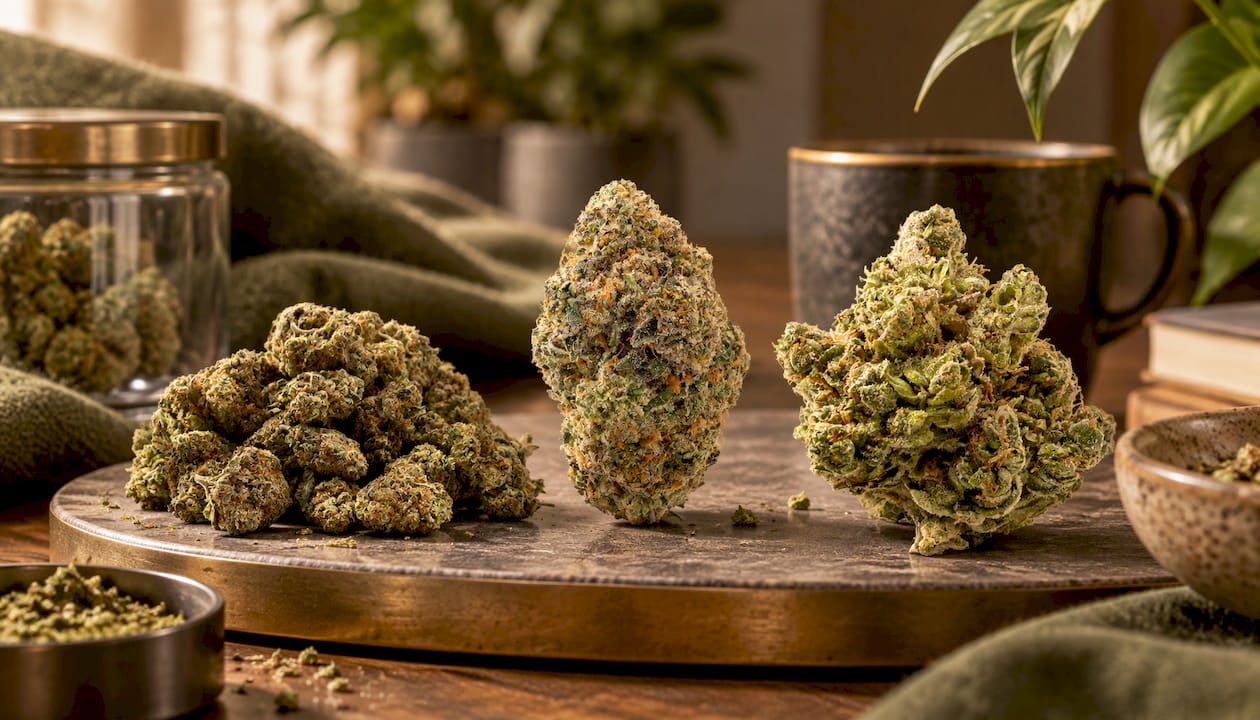
Not sure which format suits you? Our guide to finding the right strain for you walks through the basics, and you can always begin at the Burnaby Buds home page to see what is in stock. You must be of legal age in your province to order.
FAQ
What is a low percent of THC?
For inhaled products, Health Canada points new consumers to less than 10% THC with equal or higher CBD. For edibles, the figure is 2.5 mg of THC or less per dose. Anything well above those numbers is better saved for people with experience and tolerance.
Can a strain have both high THC and high CBD?
Yes, the two are independent. A product can carry strong levels of both, and it will still be potent because of the THC. If mild is what you want, look at the Total THC figure first, then at CBD.
Will a low THC strain get me high?
It can, gently. Low THC products usually produce lighter effects than high-potency ones, but a first-time user or someone with low tolerance can still feel them. Start with one or two puffs, or 2.5 mg in an edible, and give it time.
Are mild strains safe to use every day?
Lower potency lowers risk but does not make daily use low risk. Health Canada’s lower-risk guidelines identify frequent and daily use as a consistent predictor of long-term health problems. Occasional use is the safer pattern, and never drive after using.
How long should I wait before taking more?
Wait up to 30 minutes after inhaling and up to 4 hours after an edible. Taking more too early is the most common reason a mild session turns unpleasant.
Sources
- What you need to know if you choose to consume cannabis, Health Canada
- Canada’s lower-risk cannabis use guidelines, Health Canada
- How to read and understand a cannabis product label, Health Canada
- Cannabis: Lower your risks, Health Canada
- Safer use, Windsor-Essex County Health Unit
- Lower Risk Cannabis Use Guidelines for Youth, By Youth, University of Victoria CISUR
Recommended
- Exploring Beyond Expectations: The Definitive Guide to BC’s Finest Cannabis Indica Strains
- Discover the Best Cannabis Strains for a Restful Night’s Sleep
- Unveiling the Mysteries of Cannabis Strains: Your Go-To Guide for Finding the Perfect Match
- Landrace Cannabis Strains and Their Influence on BC Bud
