News
CBD Topicals for Pain: What to Know Before You Buy in Canada
Nov
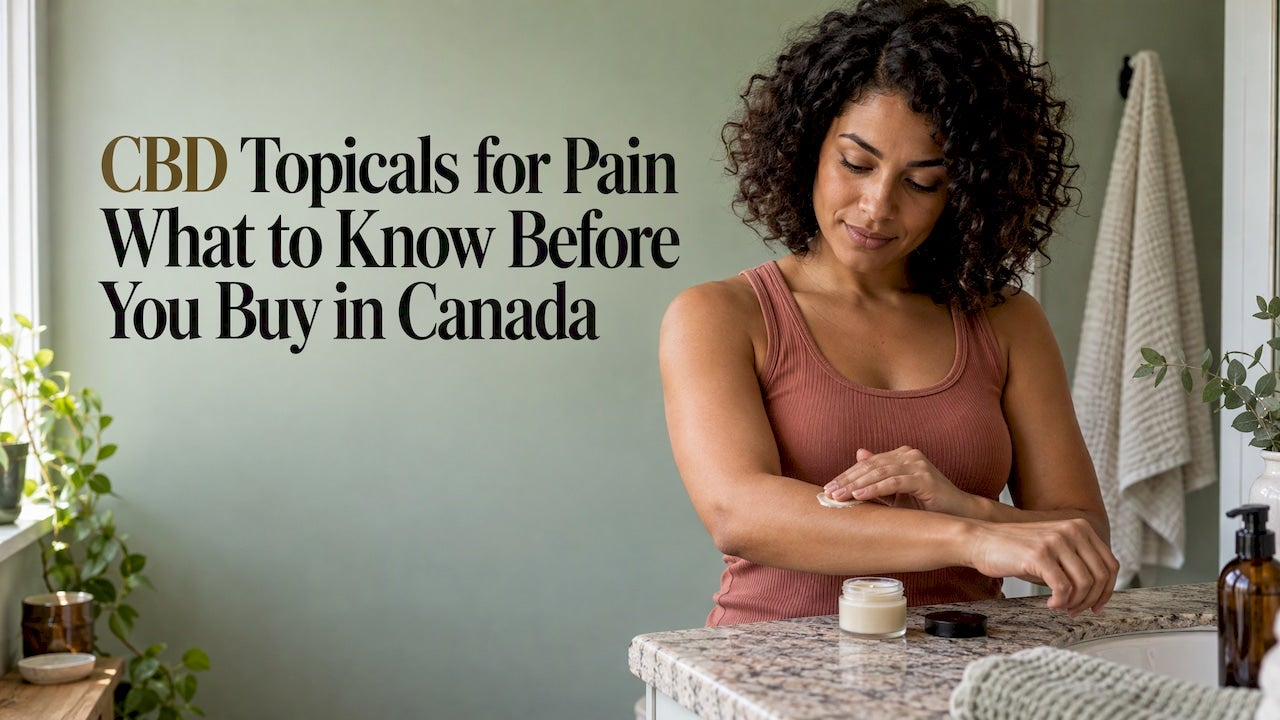
A CBD topical is a cream, balm, salve, gel or lotion that you apply to the skin over a sore spot, instead of swallowing or inhaling cannabis. Many people reach for one after a hard workout or when a joint is stiff. The research on topicals is still thin, and Health Canada does not allow health claims on them. So the best approach is to know what you are buying, read the label, start low and use the product safely. This guide covers all of that.
TL;DR
- Cannabis topicals are applied to the skin, hair or nails. They come as creams, lotions, balms, salves, gels, oils, patches and ointments.
- Canadian professional and official bodies say the evidence for topicals and pain is limited, so treat any product as a personal choice, not a proven therapy.
- Check the label for THC and CBD content, ingredients, packaging date, lot number and the excise stamp before you buy.
- Start with a small amount on a small area, and stop if you get a rash or itching.
- Pregnant or breastfeeding, on blood thinners, or living with a chronic condition? Talk to a healthcare provider first.
Table of Contents
- What a cannabis topical is, and what it is not
- What the research says about topical CBD and pain
- CBD, THC or both: choosing a formula
- How to read a topical’s label
- How to apply a cannabis topical
- Who should talk to a professional first
- Our perspective on topicals
- Browse topicals at Burnaby Buds
- Practical tips for buying topicals in Canada
- FAQ
- Sources
What a cannabis topical is, and what it is not
Health Canada lists the forms that cannabis can take when it is applied to skin, hair or nails: creams, lotions, oils, balms, salves, patches, gels and ointments. All of them are made to be used on the outside of the body. A legal product must say so on the label: it must clearly state the intended use, such as “for use on skin”, and carry a warning to keep it out of reach of children, according to Health Canada’s label guidance.
The terms people type into search boxes overlap, so here is how they sort out:
- CBD cream or CBD topical: made with cannabidiol, the non-intoxicating compound in cannabis. Readers also ask about CBD cream for sore muscles, and it falls in this group.
- THC topical cream, or “weed cream”: made with THC, the compound best known for the high. A cream is applied to the skin and sits on the surface of the body.
- Blended topicals: contain both THC and CBD, in ratios that differ from one brand to the next.
If you want a deeper look at how the two compounds differ, our guides on what separates THC from CBD and on CBD versus THC in pain management go into detail.
One point about format. Patches appear in Health Canada’s list of topical forms, so you will see them next to creams on a shelf. Any product, patch or cream, should be used exactly as its label directs, and the label is where the intended use is stated.
What the research says about topical CBD and pain
This is the part where an honest guide has to be careful, because the research is not settled and you deserve to hear that from us, not discover it later.
A Canadian pharmacy-education resource, RxFiles, states that topical cannabis cannot yet be described as evidence-based therapy, because well-designed randomized trials establishing its effectiveness are lacking. The Canadian Centre on Substance Use and Addiction says the same thing in a different way: people use cannabis topicals to manage peripheral pain and arthritis, but their effectiveness for managing health conditions has not been established.
A 2023 academic review in the Journal of Pain looked at CBD products for pain more broadly. It reported that 15 of 16 trials found no greater pain relief than placebo, while one small trial of topical CBD for thumb base arthritis found a large difference. That single result is why researchers keep studying topicals, and why more work is needed.
What does that mean for you as a buyer?
- Many people enjoy the ritual of rubbing a cream into a sore spot, and individual experiences differ.
- Nobody can promise you a result, and a trustworthy seller will not. Health Canada prohibits health or cosmetic claims on cannabis topicals, so you will not see “relieves arthritis” on a compliant package.
- If you have ongoing pain, a doctor or pharmacist should be part of the picture. The Arthritis Society Canada recommends getting a medical cannabis document from an authorized healthcare professional, rather than treating yourself with recreational products.
A topical works best as one choice within a wider plan for looking after sore muscles and joints, alongside whatever your care provider recommends.
CBD, THC or both: choosing a formula
The right formula depends on what you want from the product and how you feel about THC.
| Type | What it contains | Who tends to choose it |
|---|---|---|
| CBD-only topical | CBD, no THC listed | First-time users, people who want to avoid THC, anyone new to cannabis |
| THC topical | THC as the main cannabinoid | Experienced users who know their preferences |
| Balanced or blended topical | THC and CBD together | Users who want to try both compounds in one product |
Two useful facts for comparing. First, Health Canada sets a maximum of 1,000 mg of THC per package for cannabis topicals, so a big number on the front is capped. Second, the milligrams on the package are the total in the whole tube or jar, not the amount in each application. Divide by the size of the container to understand how concentrated the product really is.
If you are new to cannabis, a CBD-only topical is the simplest starting point. If you have used THC products before, you will already know your own tolerance, and a THC or blended topical is a natural next step.
How to read a topical’s label
Canadian packaging carries a lot of information, and it is the fastest way to tell a good product from a poor one. Health Canada advises checking these items:
- Ingredients. They are listed in descending order, so the first ones are the most plentiful. Look for anything your skin has reacted to before.
- THC and CBD content. The label shows both, which tells you whether the product is CBD-only, THC-dominant or blended.
- Packaging date and lot number. These let you check freshness and trace the batch.
- Intended use. A topical says it is for use on skin.
- Child-safety warning. Keep every cannabis product, including creams, away from children.
- The excise stamp. It indicates that the product came from a Health Canada licence holder. Certain low-THC and prescription products do not need one, so a missing stamp on a regular cannabis topical is a reason to ask questions.
This checklist works in a shop and online. When you order from us, the same details appear on each product page and package, and our support team can help you find them.
How to apply a cannabis topical
The label of your specific product always comes first. In general, the habits below fit most creams, balms and gels.
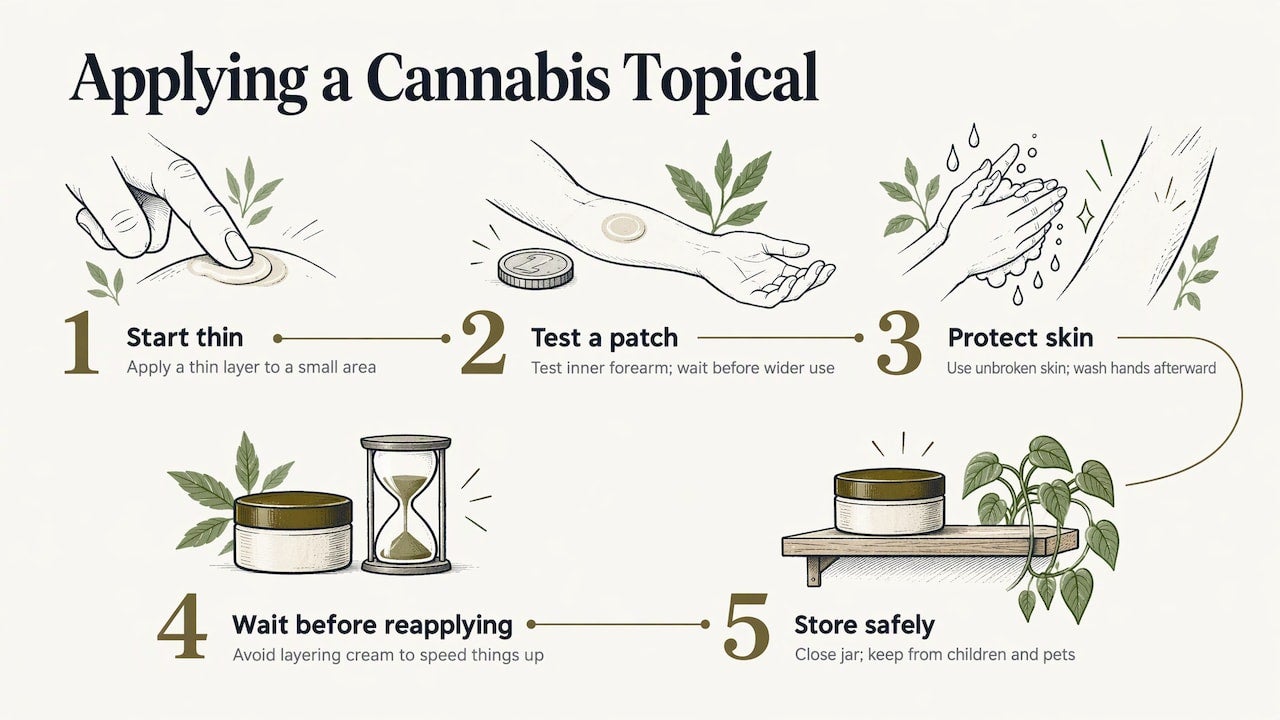
Start small. Health Canada recommends starting with the lowest dose and adjusting gradually, to reach the result you want while keeping side effects down. For a cream, that means a thin layer on a small area at first.
Test a patch of skin. Common side effects of topical cannabis are localized allergic reactions such as rashes and itching, according to the same Health Canada page. Try a coin-sized amount on the inner forearm and wait before using more widely.
Use clean, intact skin. Apply to unbroken skin only, wash your hands afterwards, and keep the product away from your eyes and mouth.
Be patient about timing. People often ask about onset time for cannabis topicals. There is no single answer, because it depends on the formula, the area and the person, and the packaging does not promise one. Give it time, avoid layering more cream to speed things up, and follow the directions on the label.
Store it safely. Keep the jar closed and out of reach of children and pets.
Who should talk to a professional first
Topical products feel gentler than edibles or vapes, but the cautions still matter, and they come from Health Canada rather than from us.
Health Canada says not to use cannabis if you are pregnant or breastfeeding, if you are under 25 (unless a healthcare provider advises otherwise), or if you live with liver, kidney, heart or blood-vessel disease, or have a personal or family history of psychosis. The same page notes that cannabis may interact with various medications, including blood thinners, immunosuppressants and medicines that cause drowsiness, so it is worth a conversation with your doctor or pharmacist if you take any of these.
If you are an older adult, our guide to cannabis consumption for seniors covers extra points to keep in mind. And if a rash appears after you apply a cream, stop using it and speak to a pharmacist or doctor.
Our perspective on topicals
At Burnaby Buds, we think a topical is one of the friendliest ways into cannabis. It is applied where you want it, it needs no inhaling and no waiting on a gummy, and it is easy to start with a small amount. That makes it a natural first purchase for casual and first-time users.
We also believe in educated buying. That is why we put guides next to our products, why our support team answers questions about THC, CBD and labels, and why we want you to read the facts from Health Canada before you choose. A customer who knows what the label says picks better and uses more comfortably.
Our range includes CBD products and cannabis topicals, so you can compare formulas in one place, whether you want a CBD-only option or something with THC. We deliver quickly across Canada, with same-day delivery available in our home area, so you are not left waiting when you have decided.
the author
Browse topicals at Burnaby Buds
If you are ready to compare creams, balms and other topicals, our shop lists CBD products, cannabis topicals and the rest of our range with clear product details. Our team is available if you want help reading a label or picking between CBD and THC.
See our full product categories to find topicals, CBD products and accessories, and place an order for delivery.
Practical tips for buying topicals in Canada
- Buy from a source you can check. Look for the excise stamp and a full label, as covered above.
- Choose one change at a time. If you try a new product, avoid starting a second new product the same week, so you know which one agrees with you.
- Keep notes. Write down the product, the amount, the area and how it felt. It helps you decide what to buy next and gives your pharmacist something concrete to review.
- Mind other cannabis use. A topical is not a reason to ignore the cautions that apply to the rest of your cannabis use.
- Read more when you want it. Our article on the healing potential of cannabis gives further background.
FAQ
Is topical CBD good for pain?
The evidence is not strong enough to say. Canadian professional and official sources describe the clinical evidence for cannabis topicals as limited and their effectiveness as not established. Some people like using them, but nobody can promise a result, and ongoing pain deserves a conversation with a healthcare provider.
Is weed cream the same as CBD cream?
No. CBD cream is made with cannabidiol, while a THC topical cream is made with THC, and some products contain both. Check the label for the THC and CBD content to see which kind you are holding.
Who should not use CBD cream?
Health Canada advises against cannabis use during pregnancy and breastfeeding, for people under 25 unless a provider advises otherwise, and for people with liver, kidney, heart or blood-vessel disease or a personal or family history of psychosis. It also warns of possible medication interactions, including with blood thinners, so check with a doctor or pharmacist if you take any.
What side effects can a topical cause?
The most common ones Health Canada names are localized allergic reactions such as rashes and itching. Test a small patch of skin first, use the lowest amount, and stop if irritation appears.
How do I know a topical is legal and genuine?
Read the label. A legal Canadian product shows its ingredients, THC and CBD content, packaging date and lot number, and usually an excise stamp showing it came from a Health Canada licence holder.
Sources
- Topical Cannabis: Does it Live Up to its Presumed Potential? (RxFiles)
- Cannabidiol (CBD) Products for Pain (The Journal of Pain)
- Edible Cannabis, Cannabis Extracts and Cannabis Topicals (CCSA)
- Using a cannabis product (Health Canada)
- Cannabis for medical purposes: General information (Health Canada)
- How to read and understand a cannabis product label (Health Canada)
- Proposed regulations for additional cannabis products (Health Canada)
- Medical Cannabis: CBD and THC (Arthritis Society Canada)
Recommended
- CBD vs THC: Comparing Their Uses in Pain Management
- Beyond the High: Unveiling the Healing Potential of Cannabis
