
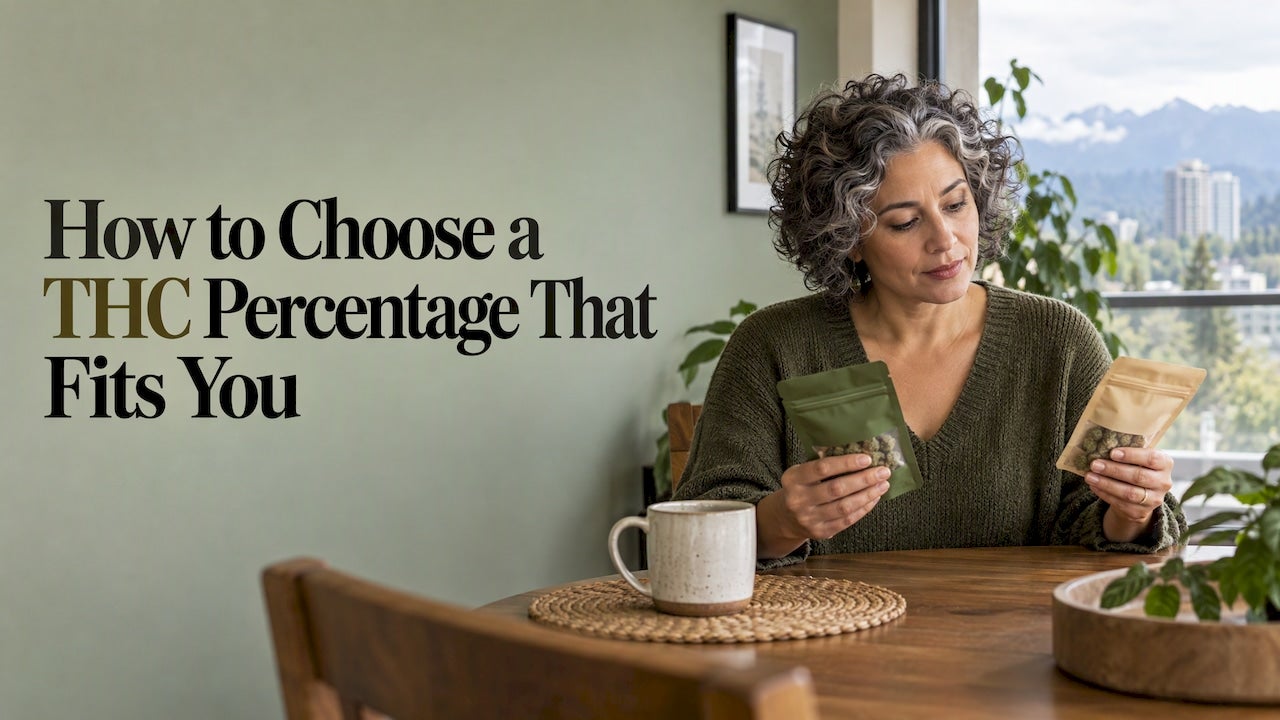
Choose the THC percentage by your experience, not by the biggest number on the shelf. If you are new to cannabis, Health Canada’s guidance for inhaled products points to less than 10% THC with equal or higher CBD. Occasional users usually do well in the 10 to 20% range. Experienced users can go higher, and they still need to match the format and the dose to their tolerance. We sell flower, edibles, concentrates and vapes across Canada, so this guide shows how to read each label and pick the right strength before you order.
TL;DR
- Health Canada advises new consumers who inhale to choose products under 10% THC (100 mg/g) with equal or higher CBD, and to wait up to 30 minutes before taking more.
- THC percentage only compares like with like. Flower, concentrates, vapes and edibles are measured differently, so you cannot compare them by one number.
- For edibles, the number that matters is milligrams of THC per piece. Start at 2.5 mg or less.
- A higher percentage does not guarantee a better experience. Terpenes, CBD, your tolerance and the format all shape how a product feels.
- Pick the strength first, then the product. Our team can help you match the two when you order.
Table of Contents
- What the THC percentage on a Canadian label tells you
- Is 20% THC strong?
- Starting points by experience level
- Compare formats by dose, not by percentage
- Does a higher percentage mean a better high?
- A four-step way to choose your strength
- Find your strength with Burnaby Buds
- FAQ
- Sources
What the THC percentage on a Canadian label tells you
THC (delta-9-tetrahydrocannabinol) is the main compound that causes the high. Health Canada explains that it is the main cannabinoid responsible for intoxication, along with common effects such as dry mouth, red eyes and a faster heart rate.
Every legal Canadian product must show Total THC and Total CBD on the front of the package. How the amount is shown depends on the product:
- Dried flower and many extracts: by weight, for example Total THC 180 mg/g. That is 18%, because 1 mg per gram equals 0.1%.
- Edibles and capsules: per unit, for example 2.5 mg per gummy.
- Sprays and vapes with activations: per activation, for example 8 mg per spray.
The label also carries a standardized cannabis symbol on products with more than 10 micrograms of THC per gram, and it is printed in French and English, as Health Canada’s label guide explains.
The quick conversion: mg/g divided by 10 equals percent. A flower labelled 220 mg/g is 22% THC. A label that gives only milligrams per unit is telling you the dose directly, and no conversion is needed.
How accurate is the number?
A 2025 peer-reviewed study of flower and concentrates in Scientific Reports found labelled THC accurate within 15% for almost all tested products. It reported a mean labelled potency of 22.5% for flower against 20.8% observed. Treat the percentage as a good guide and not as a precise dose. A 20% flower might behave like an 18% or a 22% one. That is another reason to take a small first dose and increase slowly.
Is 20% THC strong?
Yes, for most people it sits at the strong end. Ottawa Public Health publishes a potency chart based on Ontario Cannabis Store categories. It is a useful reference point for flower:
| THC in dried flower | How it is described |
|---|---|
| 0 to 1.99% | Little to minimal |
| 2 to 6.99% | Very mild |
| 7 to 11.99% | Mild |
| 12 to 16.99% | Medium |
| 17 to 20% | Strong |
| Over 20% | Very strong |
The chart comes from Ottawa Public Health’s lower-risk cannabis page, which also suggests starting with one or two puffs of a product at 10% THC or less.
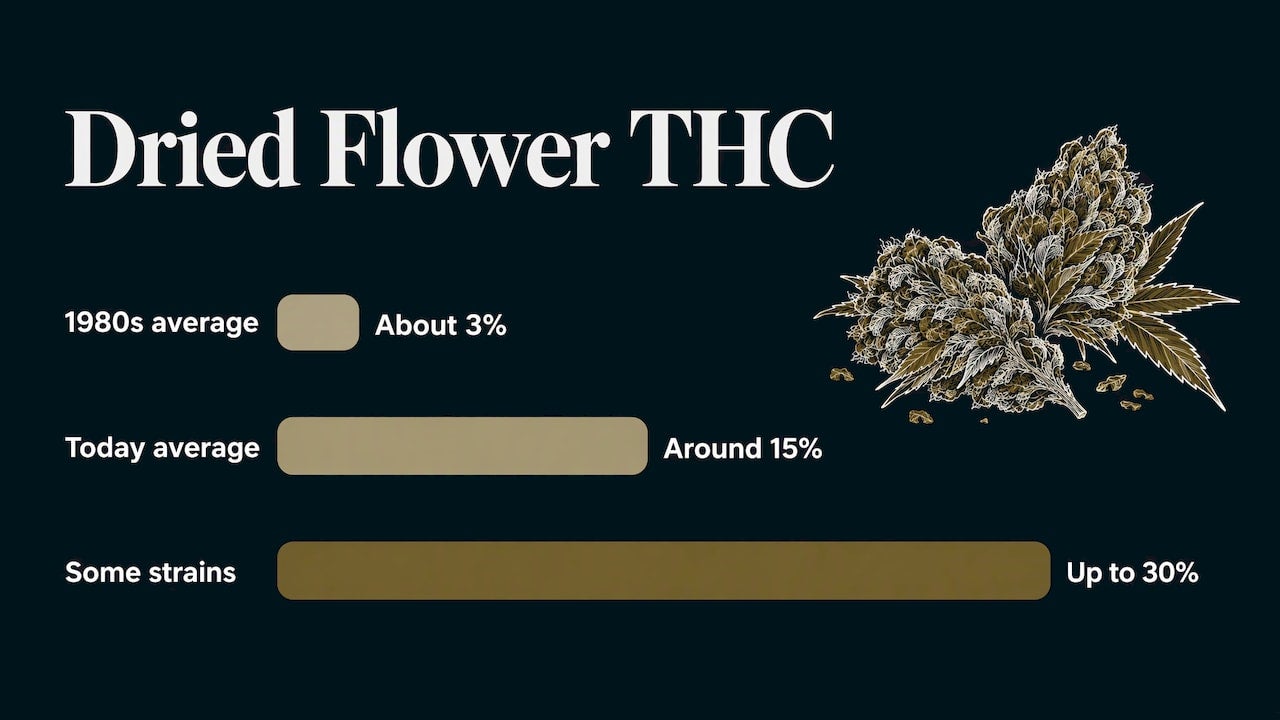
For context, Health Canada notes that THC in dried cannabis has risen from about 3% in the 1980s to around 15% today, with some strains averaging as high as 30%. A 20% flower is no longer unusual on the shelf, but it is still a strong product for someone with little tolerance.
Is 35% THC a lot?
For flower, 35% is at the very top of what exists. Even in the 2025 study above, flower labelled up to 39% was an outlier. The observed average was 20.8%. In concentrates the picture is different: the same study measured concentrates averaging 70.7% THC, so 35% is low for that category. This is why one percentage means nothing until you know the format.
If you see 30% or more on flower, treat it as a product for experienced consumers with high tolerance. Health Canada’s guidance asks for the most caution above 20%.
Starting points by experience level
Health Canada’s consumer guidance for inhaled cannabis uses three bands. We have added a plain-language starting point for each.
| Your experience | THC range to look at | How to start |
|---|---|---|
| First-time or very rare user | Under 10% (100 mg/g), with equal or higher CBD | One or two puffs, then wait up to 30 minutes |
| Occasional user | 10 to 20% (100 to 200 mg/g) | Take it slowly and keep sessions short |
| Regular, experienced user | Above 20% (200 mg/g) | Take the most care; shatter, wax and distillates sit here |
The bands come from Health Canada’s guidance on consuming cannabis. The Windsor-Essex County Health Unit gives the same advice for inhaled extracts and adds that harms increase with stronger products, frequent use and use under age 25.
A worked example
Say you have tried cannabis twice at a party and want something for a quiet evening at home. A flower labelled 140 mg/g is 14% THC. That sits in the 10 to 20% band, so it calls for caution. A 90 mg/g flower (9%) with some CBD sits in the beginner band. The 9% flower is the better first choice. Take one or two inhalations, wait the full 30 minutes, and only then decide whether you want more. If the 9% feels flat after a few sessions, you can step up to the 12 to 16% range and repeat the same slow routine.
Our guide to low THC strains goes deeper on mild options. If you are unsure how CBD changes the experience, see the difference between THC and CBD.
Compare formats by dose, not by percentage
A flower at 20% and a vape at 20% are not the same experience. Concentrates, vapes and edibles deliver THC differently, and the label shows different units for each.
Flower and pre-rolls
Percentage is the number to use here. Effects begin within seconds to minutes when smoked or vaped, peak at about 30 minutes and can last up to 6 hours or more, according to Ottawa Public Health’s timing chart. Fast onset makes flower easy to adjust. You can stop after a puff or two and see how you feel. Browse cannabis flower and compare labels using the table above.
Vapes and concentrates
These products are concentrated by design, and they sit in the over-20% band that calls for the most care. Health Canada names shatter, wax and distillates as examples. If you are new to the category, start with the smallest draw and wait before another. Lower-THC options with CBD are the natural first step. When you are ready for more, our vape pens and refills and concentrates are both available with delivery. Our own explainers on cannabis distillate and live resin show what each type is.
Vaping is also worth a note on safety. Ottawa Public Health advises vapers to watch for cough, shortness of breath or chest pain, to seek medical attention if concerned and to tell their health care professional what they vape.
Edibles
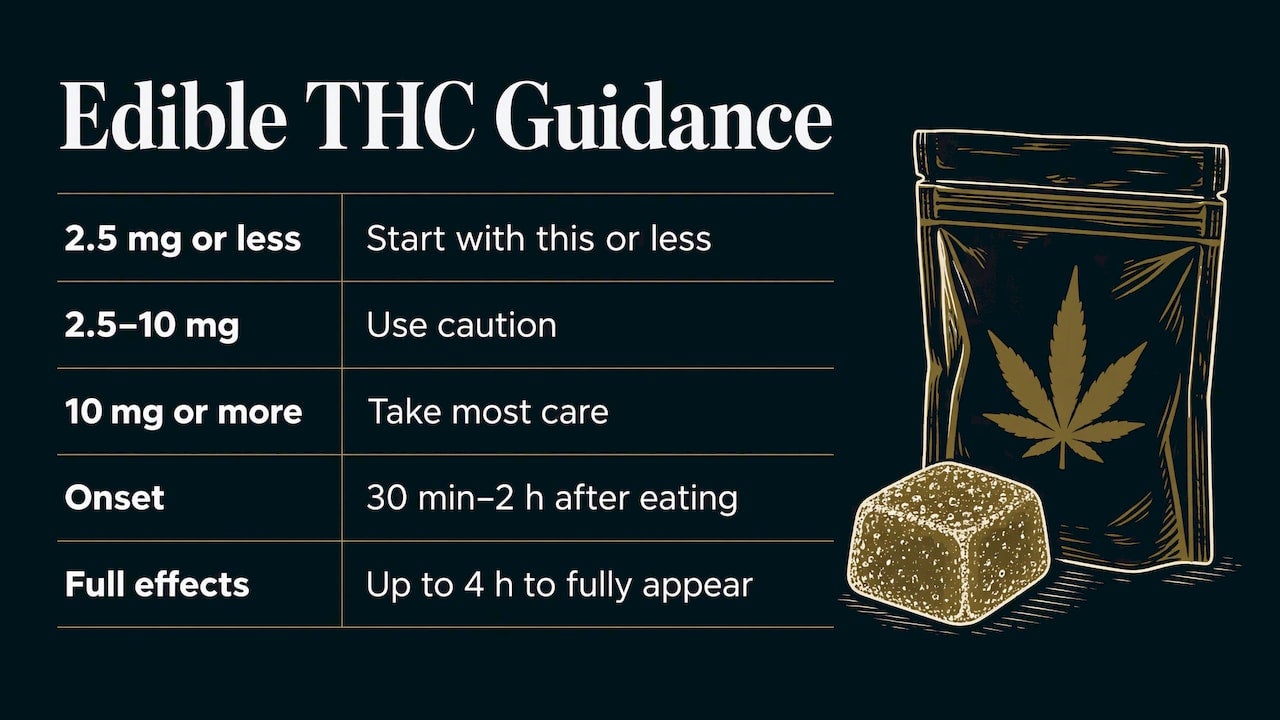
With edibles, ignore percentage and read milligrams per piece. The body converts eaten THC into a stronger compound, 11-hydroxy-THC, and onset is slow. Health Canada advises new consumers to start at 2.5 mg THC or less, use caution from 2.5 to 10 mg and take the most care at 10 mg or more. Effects can begin 30 minutes to 2 hours after eating and take up to 4 hours to fully appear.
The British Columbia government’s edibles fact sheet adds practical guidance: wait at least 2 hours before a second 2.5 mg dose. Effects can last 4 to 12 hours and sometimes up to 24. Too much can cause extreme sedation, anxiety, paranoia, a rapid heartbeat or hallucinations. If that happens, BC Poison Control is 1 800 567-8911. In an emergency, call 911.
A package that says “250 mg” total is usually split into many pieces. A 10-piece pack with 25 mg per piece holds 250 mg, but one piece is 25 mg, ten times the beginner start. Always divide the total by the number of pieces. Our edibles onset time guide explains the wait in more detail.
Does a higher percentage mean a better high?
Not necessarily. Two products with the same THC number can feel different, and a higher number can bring more side effects without more enjoyment. Several things matter besides the percentage:
- Tolerance. Daily or frequent use raises tolerance. A strength that overwhelms a beginner may feel mild to a regular user.
- CBD. CBD is the other main cannabinoid, and Health Canada’s beginner advice pairs low THC with equal or higher CBD for that reason. Our CBD dosage guide covers how much to take.
- Terpenes. These are the aroma compounds, such as limonene (citrus) or linalool (floral). Many consumers use them to choose between a more uplifting or more relaxing product. Our guide to sativa, indica and hybrid is a good starting point.
- How you take it. Inhaling, eating and vaping differ in speed, peak and length of effect.
- Your setting. Time of day, food, sleep and company all change how a dose lands.
The cost angle is practical too. If a 16% flower gives you the effect you want, you do not need to pay for a 28% product. Picking the right strength is often the more affordable choice.
A four-step way to choose your strength
- Name your experience honestly. Never used, a few times a year, weekly, or daily. Each points to a different band in the table above.
- Choose the format. Flower and pre-rolls are easy to adjust in small steps. Edibles last longer and need patience. Vapes and concentrates are the most concentrated.
- Read the front of the label. Convert mg/g to percent for flower, and read mg per piece for edibles. Check the CBD figure too.
- Start low and wait. Inhaled: wait up to 30 minutes. Eaten: wait at least 2 hours before a second small dose. Write down what you took and how it felt, so your next order is easier.
Plan a session at home with no driving, and keep products out of reach of children and pets.
What we tell customers about potency
Most first orders we see in a guide like this come down to one worry: picking something too strong. Our view is that the right THC percentage is the one that matches your experience, your format and your evening. We built our shop around that idea, with educational guides, personalized customer support and a range that runs from mild flower and low-dose edibles to premium concentrates.
For newcomers, we would start with a mild flower or a low-dose edible and follow the waiting times Health Canada gives. For casual users, a mid-range flower often covers what they want at a fair price. For experienced users, we carry stronger flower, concentrates and vapes, and the same rule applies: read the label, know the dose, and give it time.
Strength is only one part of a good choice, and we would rather you order the product that suits you than the one with the biggest number.
the author
Find your strength with Burnaby Buds
We are an online dispensary delivering to residents of Canada, with same-day delivery and customer support that can help you match a product to your experience level. You can browse flower, edibles, concentrates, vape pens, CBD and more on our product categories page. Check the THC and CBD figures on each product, use the bands in this guide, and begin with the lowest dose that suits you.
If you want a gentle start, try cannabis edibles and check the milligrams per piece before you order.
FAQ
What percentage of THC is best?
There is no single best percentage. For new consumers who inhale, Health Canada advises under 10% THC with equal or higher CBD. Occasional users often choose 10 to 20%, and experienced users may prefer more. The best number is the one that suits your tolerance and your chosen format.
Does a higher THC percentage always mean a better high?
No. Terpenes, CBD, your tolerance and the way you consume all shape the experience. A higher percentage can bring stronger side effects, such as anxiety or dizziness, and it costs more. Many people find a mid-range product more enjoyable than the strongest one on the shelf.
What THC percentage should a beginner choose?
Start under 10% THC (100 mg/g) with equal or higher CBD for flower and vapes, and 2.5 mg THC or less for edibles. Take one or two inhalations and wait up to 30 minutes. With edibles, wait at least 2 hours before a second small dose.
Is 20% THC considered strong?
Yes. Ottawa Public Health’s chart labels 17 to 20% as strong and anything above 20% as very strong. Health Canada asks consumers to take the most care above 20%. If you are new, a lower percentage is the safer starting point.
Sources
- How to read and understand a cannabis product label, Health Canada
- About cannabis, Health Canada
- What you need to know if you choose to consume cannabis, Health Canada
- Lower Risk Cannabis Use, Ottawa Public Health
- Cannabis Edibles, Windsor-Essex County Health Unit
- Accuracy of labeled THC potency across flower and concentrate cannabis products, Scientific Reports