
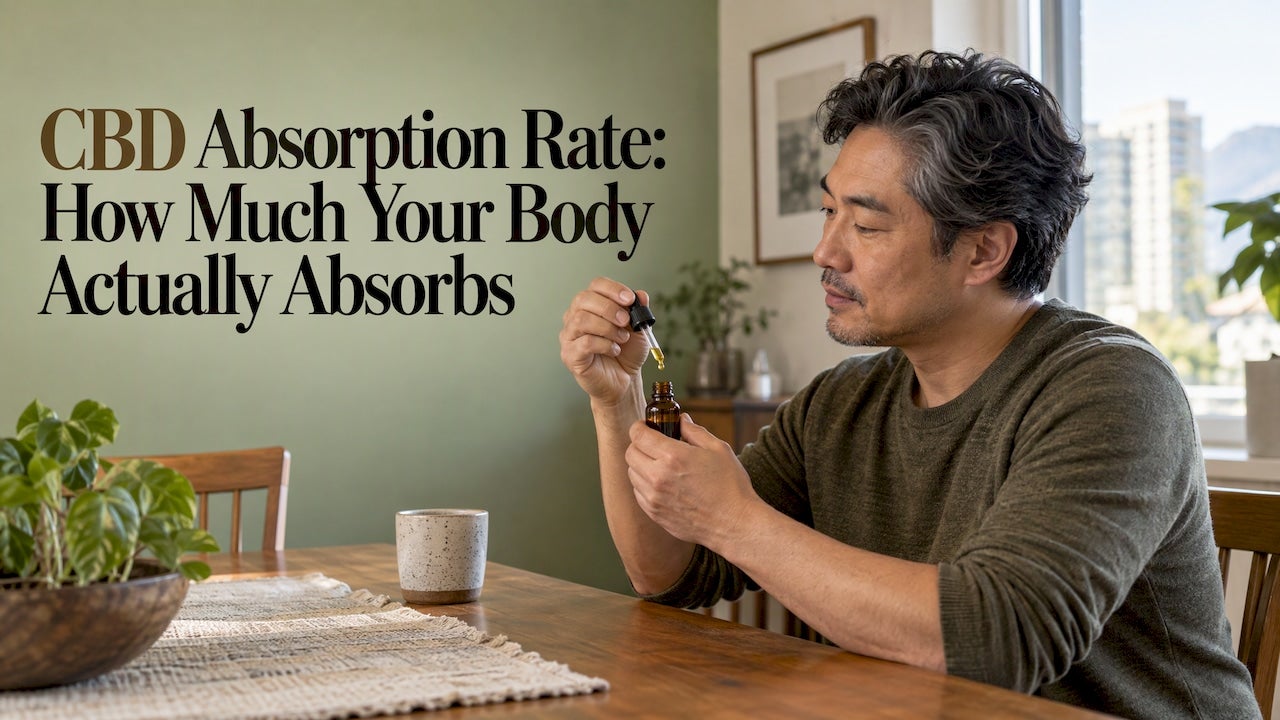
CBD absorption is not one number. Swallowed CBD oils and edibles are estimated at roughly 6% to 20% bioavailability, meaning the share of a dose that reaches your bloodstream. Inhaled CBD is estimated at 11% to 45%, and CBD creams mostly stay in the skin. What you eat with it, the carrier oil and the strength of the product all move those numbers. Pick the form that matches your goal, read the strength on the label as milligrams per serving, and start low.
This guide is for Canadian adults who want to buy CBD with confidence, whether it is a first bottle of oil or a switch to something stronger. It gives the numbers, shows how to turn a label into a dose, and explains what changes absorption.
TL;DR
- Swallowed CBD (oils, capsules, gummies) has an estimated oral bioavailability of about 6% to 20%, and it varies a lot from person to person.
- Taking CBD with a meal that contains fat can raise absorption several-fold, according to Canadian drug-monograph data.
- Topical CBD works mainly in the skin. Very little reaches the bloodstream, so a cream is a local product, not a substitute for oil.
- Oil strength is written as a percentage or mg/mL: 5% to 30% equals 50 to 300 mg of CBD per millilitre.
- Health Canada’s expert committee found 20 mg a day up to 200 mg a day safe for healthy adults for up to 30 days. Talk to your pharmacist first if you take other medication.
Table of Contents
- What “CBD absorption rate” means
- Absorption by method at a glance
- How fast each form starts working
- Oils and sublingual use: the “hold it under your tongue” question
- Food changes absorption more than most people expect
- Formulation: why two 10 mg products are not the same
- Topicals: absorption into skin, not into blood
- Reading CBD strength: concentration and oil strengths
- How much to take, and who should be careful
- Getting more from your CBD: a practical routine
- Our view on absorption
- Shop CBD by form
- FAQ
- Sources
What “CBD absorption rate” means
Bioavailability is the percentage of what you take that ends up circulating in your blood. If you take 10 mg of CBD and 10% is bioavailable, about 1 mg is doing the work. The rest is lost along the way: undissolved in the gut, broken down by the liver, or stuck in the skin.
Health Canada’s information for health-care professionals explains that cannabinoids can be taken by inhalation, by mouth, rectally or through the skin, and that each route means absorption through a different organ: lung, intestine, colon or skin. That is why the same milligram count behaves differently in a vape, a capsule and a balm.
There is a second reason the numbers are low. CBD is highly fat-loving (lipophilic) and does not dissolve well in the watery environment of the gut. A 2026 review of CBD supplements notes that oral bioavailability of CBD oils is low and variable, estimated at 6% to 20%. A 2025 review puts it at 6% to 19%, because CBD dissolves poorly in the intestine and is heavily processed by liver enzymes on its first pass.
Absorption by method at a glance
These are published estimates, not promises. People differ, and so do products.
| Method | Estimated bioavailability | Typical onset | Where the CBD goes |
|---|---|---|---|
| Oils, capsules, gummies (swallowed) | About 6% to 20% | 30 minutes to 2 hours, full effect up to 4 hours | Gut, then liver |
| Oil held under the tongue | Similar to swallowed in practice | Similar to swallowed | Some mouth lining, most swallowed |
| Inhaled | 11% to 45% (mean about 31%) | Seconds to minutes, full effect in 10 to 30 minutes | Lungs, then blood |
| Creams, balms, bath products | Under 1% in one human study | Hours to days for any blood level | Mostly stays in the skin |
The oral range comes from the reviews above. The inhaled figure comes from a 2020 pharmacokinetics review reporting 11% to 45% with a mean of 31%, against about 6% orally. Onset times are from Health Canada’s consumer guidance, covered next.
How fast each form starts working
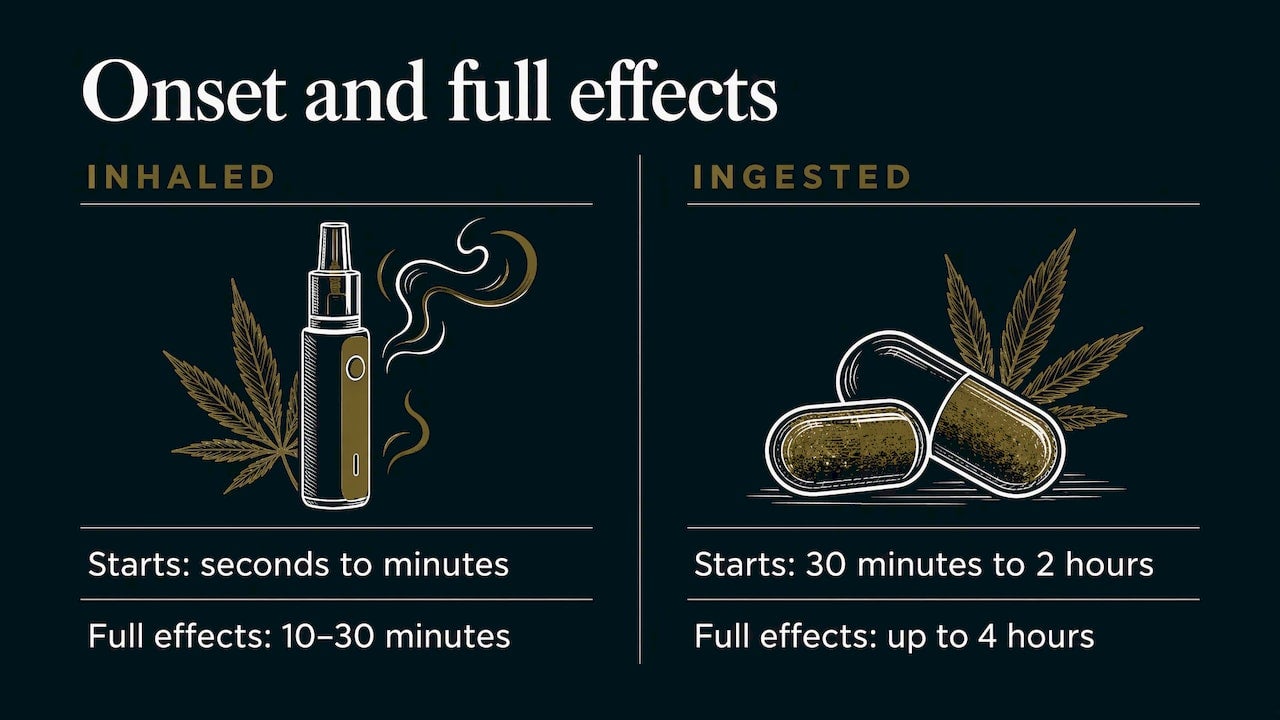
Speed and absorption are different questions, but readers usually want both. Health Canada says that inhaled cannabis starts working within seconds to minutes, with full effects in 10 to 30 minutes, while ingested cannabis takes 30 minutes to 2 hours to begin and up to 4 hours to reach full effect. The same page warns against combining cannabis with nicotine, alcohol, other drugs or health products, because impairment and side effects can increase.
For swallowed CBD, a systematic review of human studies found that peak blood levels are mostly reached between 1 and 4 hours after oral or oromucosal dosing. If you want a plain-language walk through how fast CBD takes effect for each delivery method, that guide covers the same ground from another angle.
The practical lesson for edibles and capsules is patience. Taking a second serving at 45 minutes because “nothing happened” is the classic way to overshoot. Our guide on how long edibles take to kick in explains the wait in more detail.
Oils and sublingual use: the “hold it under your tongue” question
Many labels tell you to hold oil under the tongue for 60 to 90 seconds. The idea is that the lining of the mouth absorbs some CBD directly and skips the liver’s first pass. It does work partly: the 2026 review explains that sublingual use partly bypasses first-pass metabolism, but some of the dose is swallowed, so total bioavailability is the sum of mouth and gut absorption.
How much difference it makes is still being studied. A 2024 review reports that a human study found no difference in peak level or timing between a 50 mg sublingual wafer and oral oil, and suggests saliva carries much of a sublingual dose to the gut. A 2024 meta-regression of 39 studies likewise found that oromucosal dosing was associated with lower peak levels and total exposure than oral dosing.
What to do with that: holding oil under the tongue is harmless and a fine habit, but count on swallowed-oil numbers when you work out a dose. Treat any extra from the mouth as a bonus.
Food changes absorption more than most people expect
The single easiest way to change how much CBD you absorb is what is in your stomach. Canada’s drug monograph for a prescription CBD medicine (May 2024) reports that a high-fat meal raised peak CBD levels 5-fold and total exposure 4-fold compared with fasting, a low-fat meal 4-fold and 3-fold, and milk about 3-fold and 2.5-fold. The same page notes that alcohol raised exposure by 63% and can add to sleepiness and sedation.
That is why a dose on an empty stomach and the same dose after dinner can feel like two different products. The 2024 meta-regression agrees: fed status was linked to higher peak and total exposure.
Two habits follow from this:
- Take CBD the same way every time, with or without food, so you can judge your dose fairly.
- If you switch from taking it fasted to taking it with a fatty meal, treat it as a dose increase and go back to a smaller serving.
Formulation: why two 10 mg products are not the same
A milligram of CBD in one product is not always a milligram absorbed the same way. The carrier oil and the way the CBD is dispersed matter. A 2024 review explains that lipid-based formulations improve absorption mainly through lymphatic transport, which avoids some first-pass loss, and that one engineered formulation raised exposure about six-fold in animals.
Some research data point the same way:
- In a 2025 rat study, every tested formulation beat plain sunflower-oil CBD, and a 16 µm emulsion reached 291% of the reference exposure. Too much emulsifier or lecithin cut absorption again.
- In healthy volunteers, liposomal CBD raised total exposure and peak levels versus crystalline CBD.
Most of that evidence is from animals or specialised formulations, so do not expect a fixed multiplier from a shop-bought bottle. What it shows is that the carrier oil, and whether a product is an oil, a capsule or a gummy, is part of the dose.
Topicals: absorption into skin, not into blood
People often ask which CBD formulation has the highest skin absorption. Skin is a barrier, and CBD creams are built to deliver into the skin, not through it.
- A human-skin study from 2020 found that a hydrophilic gel outperformed a lipophilic ointment and a patch for skin retention and permeation, with most CBD held in the epidermis.
- A 2024 study found that permeation across skin from control formulations was below detection after 48 hours, meaning most topical CBD stays in the skin.
- In a 2026 crossover study, a hemp-extract cosmetic had 0.69% bioavailability and took 24 hours to peak, against 3 hours for oral dosing.
- A 2024 trial of five commercial topicals in 46 adults saw absorption for three products, peaking after 7 to 10 days, highest in a lotion with the most CBD plus a permeation enhancer.
So strength and ingredients matter on skin: a 2022 laboratory study found that a 5% CBD solution delivered about ten times more CBD into skin than a 1% solution, and oleic acid boosted delivery.
The takeaway: choose a topical when you want a product for a specific area, and choose an oral product when you want whole-body levels. Our guide to CBD topicals for pain covers what to look for on the label. For something to start with, the Marena Wellness CBD Pain Cream (300mg) is listed in our shop.
Reading CBD strength: concentration and oil strengths
Labels use two systems, and mixing them up is the most common dosing mistake.
Percentage. A CBD oil at 5% to 30% means 50 to 300 mg of CBD per millilitre in a carrier such as MCT oil.
Total milligrams. Many bottles, gummies and capsules print the total CBD in the package (for example 300 mg in a cream or 4000 mg across a bag of gummies) or per serving (for example 5 mg in a capsule).
To get your dose, you need the milligrams per serving:
- Oil: mg per mL multiplied by the volume you take. A 1 mL dose of a 50 mg/mL oil is 50 mg. A 0.2 mL dose of that oil is 10 mg.
- Capsules: the mg printed per capsule times the number you take.
- Gummies: the total in the package divided by the number of pieces. Check the per-piece figure before you eat one.
A worked example: you take 10 mg of oral CBD. With the 6% to 20% estimate, roughly 0.6 to 2 mg may reach your blood. Doubling the serving does not simply double what you feel, because absorption varies with food and formulation, so adjust slowly.
How much to take, and who should be careful
Canadian guidance gives a clear frame for healthy adults. Health Canada’s expert committee concluded that CBD is safe and tolerable for up to 30 days at 20 mg per day, up to a maximum of 200 mg per day by mouth, in capsules or oils, provided adults discuss other medications with their pharmacist. It found no evidence supporting long-term safety and advised seeing a physician if you need CBD beyond 30 days. It also said doses above 200 mg per day are not appropriate for self-selection.
The same review lists side effects including drowsiness, nausea, decreased appetite, dry mouth, liver function abnormalities and changes in how prescription drugs act. CBD is processed by the same liver enzymes (CYP3A4 and CYP2C19) as many medicines, so if you take any prescription drug, ask your pharmacist before starting. Do not combine CBD with alcohol, and see your physician first if you have liver problems.
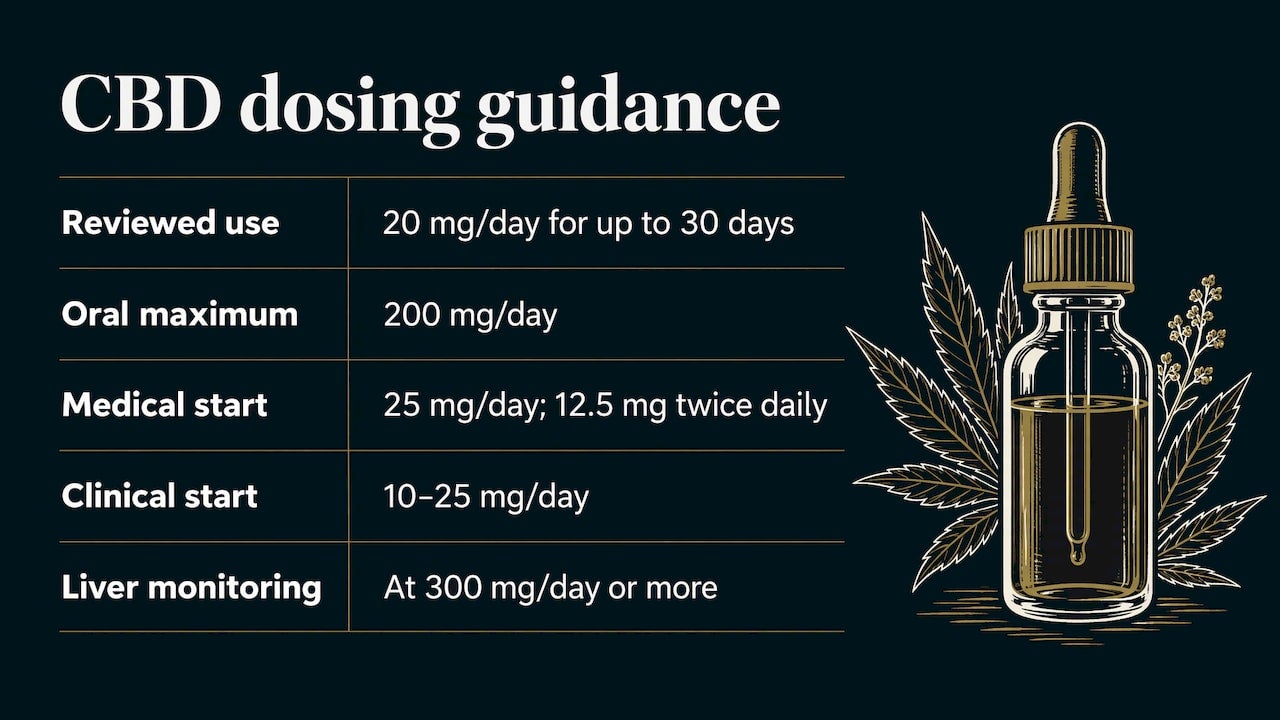
For starting doses, Health Canada’s medical guidance suggests 25 mg of CBD per day, split into two doses of 12.5 mg, and notes that higher doses make side effects more likely. A 2024 clinical review recommends starting oral CBD at 10 to 25 mg a day and monitoring liver enzymes for anyone taking 300 mg a day or more. Both frames say the same thing: start low, go slow. Our CBD dosage guide for Canada turns this into a step-by-step plan.
Getting more from your CBD: a practical routine
- Choose the form for the job. Oral for whole-body use, a topical for one area.
- Use a consistent routine. Same time of day, same food context.
- Take it with a meal if you want fuller absorption, and lower the serving when you first do so.
- Wait before adjusting. Allow up to 2 hours for oral products before judging, and change the dose in small steps, not daily jumps.
- Keep a note of dose, form and effect for a couple of weeks so you can see what works.
If you are new to this, our cannabis buying guide explains how to read labels and choose a product type before you order.
Our view on absorption
Most people ask us about CBD absorption after a bottle or a gummy “did nothing” or felt different from last time. The answer is almost always in the details: the form, the carrier oil, the serving size and whether it was taken with food.
That is why we run our CBD range by form. Oils and capsules are for oral use, gummies are for a measured serving, and topicals are for a specific area. We list strengths such as LYFE CBD Capsules at 5mg so you can work out a serving before you order, and our educational guides exist so first-time buyers can read a label with confidence.
Our advice is simple: pick the form that suits your goal, take it consistently, keep a short log, and start with a small serving. Our team offers personalized customer support if you want help matching a product to what you need.
the author
Shop CBD by form
Burnaby Buds is an online dispensary serving Canadian residents of legal age, with same-day delivery, customer support and educational guides. Our CBD range includes oils such as Viridesco RSO CBD Hemp Oil, LYFE CBD Capsules (5mg), Big Bang CBD Gummies (4000mg) and topicals. Browse every category on our product categories page.

If you prefer a mild experience while you figure out your dose, our guide to low THC strains is a good next read.
FAQ
Does holding CBD oil under the tongue improve absorption?
It may help a little, because part of the dose is absorbed through the mouth lining and avoids the liver’s first pass. Studies suggest much of it is swallowed anyway, so total exposure ends up close to swallowed oil. Hold it for 60 to 90 seconds if you like, but plan your dose as if it were oral.
Is 10 mg of CBD oil a lot?
No, it is a modest serving. Health Canada’s medical guidance suggests starting at about 25 mg a day, split into two doses, and the expert committee’s range for healthy adults is 20 mg to 200 mg a day for up to 30 days. Begin lower if you are new to CBD or take other medication, and talk to your pharmacist.
What should you not mix CBD with?
Avoid alcohol, since it can raise CBD exposure and add to drowsiness. Be careful with prescription medicines, because CBD is processed by liver enzymes that handle many drugs. Health Canada also advises against combining cannabis with nicotine or other drugs. Ask your pharmacist before combining anything.
What does a 30% CBD oil mean?
A 30% oil contains 300 mg of CBD per millilitre, and a 5% oil contains 50 mg per millilitre. The percentage says how concentrated the oil is, not how much to take. Multiply the mg per mL by the volume of your dose to get milligrams.
Sources
- Health Canada: information for health care professionals on cannabis and cannabinoids
- Health Canada: what you need to know if you choose to consume cannabis
- Health Canada: using a cannabis product for medical purposes
- Government of Canada: Review of Cannabidiol (2022)
- Health Canada drug product monograph, May 2024
- Cannabidiol in dietary supplements: characteristics and routes (2026)
- Pharmacokinetics of non-psychotropic phytocannabinoids (2025)
- Mechanisms of action and pharmacokinetics of cannabis
- A systematic review on the pharmacokinetics of cannabidiol (2018)
- Strategies to improve cannabidiol bioavailability (2024)
- Pharmacokinetics of cannabidiol: systematic review and meta-regression (2024)
- Oil-based and oil-free formulations for enhancing CBD bioavailability (2025)
- Topical administration of cannabidiol (2020)
- Cutaneous delivery and biodistribution of cannabidiol (2024)
- Exploratory crossover pharmacokinetic study of topical CBD (2026)
- Pharmacokinetics of five commercial topical CBD products (2024)
- In vitro percutaneous absorption studies of cannabidiol (2022)
- Clinical guidance for cannabidiol-associated liver injury (2024)
- How fast CBD takes effect