

A joint filter, also called a crutch or tip, is a small piece of folded, rolled paper that sits at the mouth end of a joint. To make one, cut a strip of clean, semi-stiff paper, fold a few opposing accordion pleats into one end, roll the rest of the strip around the pleats, then roll the joint outward from the filter so it locks in place. It takes about a minute once you’ve done it twice. This guide covers materials, folds, placement, sizing and fixes. If you’d rather skip the step, we also explain where a ready-made cone or pre-roll fits.
TL;DR
- Use paper that is thicker than printer paper but thinner than a cereal box, with as little ink and dye as possible.
- Make two to four opposing accordion folds without creasing them, then wrap the remaining strip around the folds into a snug cylinder.
- Put the filter at one end of the rolling paper and always roll from the filter end outward so it doesn’t shift.
- Too tight to draw? Use fewer folds and roll looser. Falling out? Make the filter slightly larger.
- A filter is a mouthpiece. It improves comfort and handling, and it isn’t a health device.
Table of Contents
- What a joint filter does
- What to make a filter from
- Step by step: how to make the filter
- Sizing the filter to the joint
- Rolling the joint around the filter
- How tight should you roll?
- Fixing common filter problems
- Do you need a filter in a blunt?
- Filter types you might see in shops
- Skipping the step: cones and pre-rolls
- Our view on filters
- Get what you need delivered
- FAQ
- Sources
What a joint filter does
A crutch is one of the easiest upgrades to a standard joint, and it is essentially a mouthpiece. Leafly lists four jobs for it: it keeps the end of the joint open, supports the joint so it stays straight, blocks bits of plant matter from reaching your mouth, and helps keep your lips and fingers from burning as you smoke down to the end (the roach).
If you’ve ever had a joint go soft and collapse at the tip, or had to pick ground flower off your tongue, a filter solves both. That’s the whole case for one.
There is one thing a filter does not do. It doesn’t turn a joint into something harmless. Think of it as a tool for comfort and a cleaner draw, and judge it on those terms.
What to make a filter from
The right material is semi-stiff paper. Leafly’s guide puts it as thicker than printer paper and thinner than a cereal box, ideally with minimal ink and dyes. Printer paper is too thin and collapses when you pinch it. Thick card is too bulky to roll.
Good options you probably already have:
- Pre-cut tips. Many rolling-paper booklets come with them, and they’re the simplest option. The flap on the back of a rolling-paper pack works too.
- Index cards. Plain white ones are ideal, since they have little ink.
- Manila file folders. Cut a strip from the edge.
- Business cards. Pick matte, uncoated ones.
- Thin cardboard. The flap from a checkbook or a magazine subscription card both work.
Herb’s guide also recommends clean, ink- and chemical-free materials such as a business card strip or index card. Avoid shiny, coated stock. Glossy surfaces are the ones most likely to carry coatings you don’t want to heat and inhale, so a plain card is the safer pick.
Step by step: how to make the filter
You need a strip of paper, roughly the length of your thumb and about as wide as half your thumb. Cut it to about 2 inches by half an inch if you want a number to start from. You can trim it afterward.
Step 1: Cut or tear the strip
A straight edge helps. A ragged strip makes an uneven cylinder, which means an uneven draw. If you are using the flap from a rolling-paper pack, tear along the perforation or fold line so the edge is clean.
Step 2: Fold the accordion
At one end of the strip, fold back and forth to make a W or zigzag. Leafly says to make a few opposing folds, about as wide as the finished crutch, and not to crease them. A hard crease flattens the pleat and chokes airflow later.
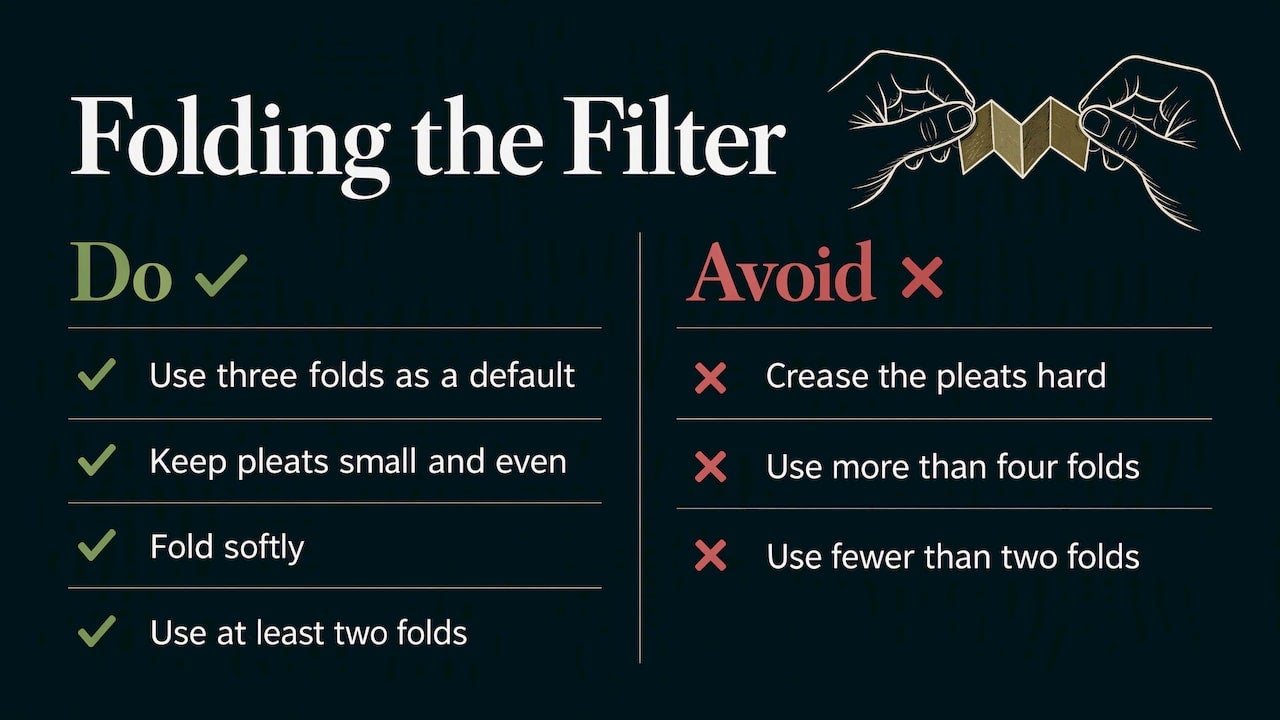
Herb suggests starting with a fold of about 0.4 to 0.8 inch (1 to 2 mm in its metric note) at the end, then alternating directions. Use that as a guide for pleat width: small, even and soft.
How many folds? Three is a good default. Fewer than two gives the filter no structure. More than four packs too much paper into a small space and the draw gets tight.
Step 3: Wrap the rest around the folds
Take the leftover flat paper and wrap it around the pleated end, rolling it back and forth between your thumb and forefinger until it holds a round shape. You want a snug cylinder. Don’t squeeze so hard that the pleats collapse.
Herb warns against rolling it too tight, because you’ll struggle to pull smoke through. Leave enough paper to wrap all the way around once, and tear off any extra.
Step 4: Check it
Pinch the cylinder lightly. It should spring back. That springiness is what Leafly says helps keep the crutch from falling out once it’s rolled into the joint. Blow through it: air should pass easily. If you can barely feel it, unroll and use fewer pleats.
An alternative: the spiral
If you don’t want to fold, you can roll the whole rectangle into a small spiral instead. The Ontario Cannabis Store’s rolling guide describes both the W fold with the rest curled around it and the spiral. The spiral is quicker. The accordion tends to give a more open draw because the pleats leave channels for air.
Sizing the filter to the joint
Match the filter to the paper. Herb advises a smaller filter for smaller joints and a larger one for bigger joints. Here is a practical way to apply that:
| Joint type | Filter size | Paper strip |
|---|---|---|
| Slim or 1¼ paper | Narrow, about the width of a pencil | Short strip, 3 folds |
| King-size paper | Slightly wider | Standard strip, 3 folds |
| Blunt wrap | Noticeably larger | Longer strip, wrapped more times |
These are working sizes, not rules. Look at the open end of your paper and make the filter just fill it. If it slides around, it’s too small. If it forces the paper to bulge, it’s too big.
Rolling the joint around the filter
Once the filter is made, the joint goes quickly. These steps follow the order in the OCS guide.
- Place the filter at the far left or right end of the rolling paper. If the adhesive strip is facing you at the top, put the filter on the side you find comfortable and keep it there every time.
- Grind your flower to an even, fluffy texture. Remove stems and seeds first. Stems poke through paper.
- Add the flower evenly along the crease, leaving a little space at the end opposite the filter. That space is where you’ll twist or tuck the tip.
- Shape the cylinder. Pinch the paper between your fingers and roll it back and forth so the flower settles into a cylinder against the filter.
- Tuck and roll. Tuck the unglued edge around the flower, then roll upward.
- Seal. Lightly moisten the glue strip and press it down.
- Pack the open end. Tamp the flower down from the end with a pen tip or a pencil, firm but not tight.
One rule matters more than the rest. Roll from the filter end outward. King Palm’s rolling guide explains why: starting at the tip lets you shape the paper around a solid core, which gives better control over tightness and locks the filter so it doesn’t slip when the joint heats up. A filter that moves mid-roll causes uneven burning and airflow problems.
How tight should you roll?
Firm enough to hold its shape, loose enough to draw easily. A joint that is too tight burns slowly and goes out. One that is too loose burns hot and fast, and flower can fall out of the end.
Pack it so the cylinder is even from the filter to the tip. If one stretch feels soft when you squeeze lightly, it will burn faster there, a problem called canoeing. Roll with consistent pressure and rotate as you go.
Fixing common filter problems
Most filter troubles come down to size and fold count.
- Too hard to draw. The filter is too tight or has too many folds. Unroll it, use two or three pleats instead of four or five, and roll it a little looser.
- Filter falls out. It’s too small for the paper. Make it a bit larger and roll it right into the joint, with the paper wrapped around it.
- Filter collapses when pinched. The paper is too thin. Switch to thicker stock and use the accordion method.
- Uneven burn or draw. Rotate the joint as you roll and keep the pressure the same along its length.
- Filter sits crooked. It wasn’t locked in. Start the roll at the filter end and keep the first pinch firm.
If you remember one thing: if it feels hard to pull on before you light it, it will be worse once it’s lit. Fix it before you smoke.
Do you need a filter in a blunt?
Usually not. Blunt wraps are stiffer, and the end can act like a crutch. Leafly notes you can add one if you like, as long as it’s bigger than a standard joint filter. Give it a longer strip, which means more wraps around the pleats.
Filter types you might see in shops
Beyond DIY paper, you’ll see two other styles for sale. Norddampf’s comparison describes cellulose filters as letting more aroma through, and activated carbon filters as making smoke noticeably milder at the cost of some flavor. Combination filters sit in between. Which suits you is personal: carbon for a gentler draw, cellulose for flavor.
The same source stresses that no filter makes smoking healthy. Treat the choice as one of comfort and taste.
Skipping the step: cones and pre-rolls
Paper crutches are easy, but they’re one more thing to cut, fold and get wrong, especially when you’re new. There are two ways to avoid the fiddly part.
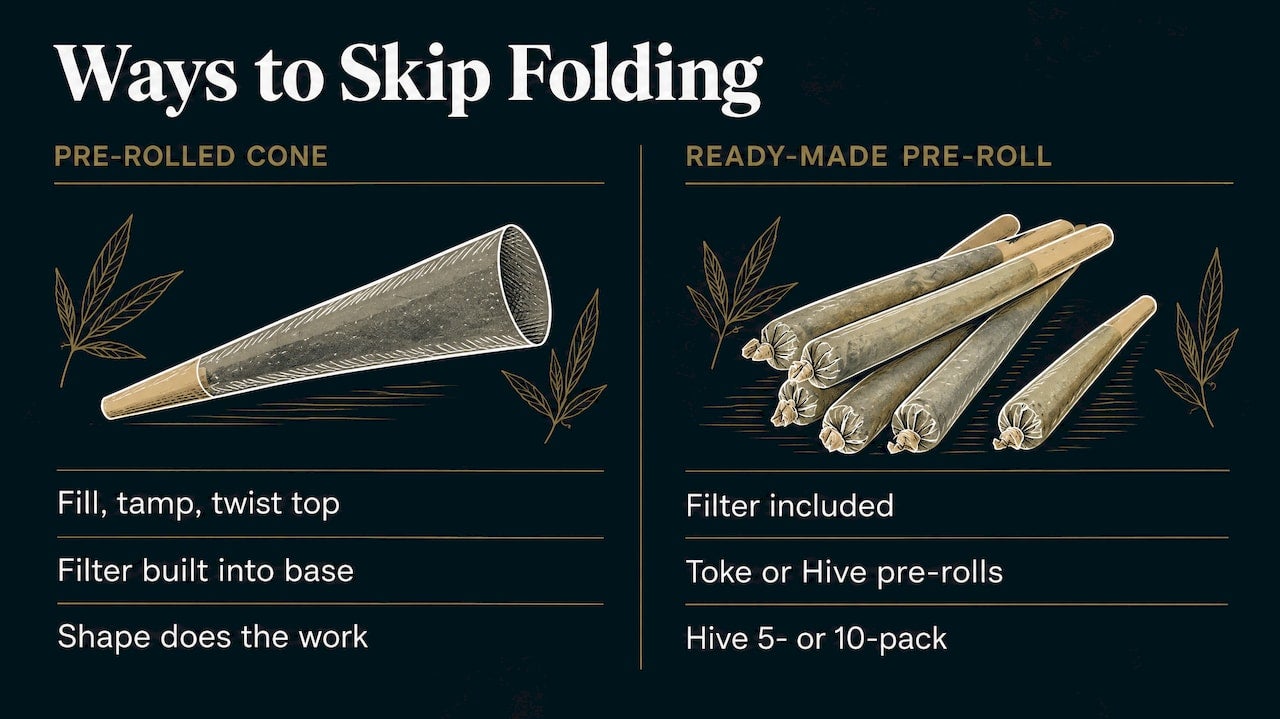
The first is a pre-rolled cone. You fill it, tamp it and twist the top. The filter is already built in at the base, and the shape does the work of the paper. We stock Blazy Susan pre-rolled cones for this.
The second is a ready-made pre-roll, filter included. Browse Toke pre-rolls, or the Hive pre-rolls in 5 and 10 packs if you’d like a few to share or keep on hand.
If you’d rather keep rolling, the paper matters as much as the crutch. Our Element 1¼ ultra thin rolling papers suit a slim filter, and Vibes organic rolling papers come in a 2 g pack. Unsure what a term means, from roach to kief? Our glossary of cannabis terms covers it.
Our view on filters
We think a crutch is the best first skill for anyone learning to roll. It costs almost nothing, it’s forgiving, and it fixes the two most irritating things about a hand-rolled joint: a soggy tip and flower in your mouth.
Our advice is to start with the accordion fold and a plain index card, size it to the paper, and roll from the filter end. After a few tries your hands learn the right pressure.
We also know that not everyone wants to roll. That’s why we carry rolling papers for people who enjoy the craft, pre-rolled cones for people who want a head start, and pre-rolls for people who want to skip it entirely. Our site is built to be easy to use, and our support team and educational guides are there for first-time buyers who want to choose with confidence.
the author
Get what you need delivered
Whether you want papers, cones or ready-made pre-rolls, you can order everything in one place from our full product range. We offer same-day delivery, and if you’re new to cannabis, our customer support and guides can help you choose.

You must be of legal age in your province to order.
FAQ
Should you roll a joint with a filter?
Most people find it worthwhile. A filter keeps the end open, keeps the joint straight, stops loose bits reaching your mouth and protects your fingers as the joint burns down. It’s optional, and you can skip it in a blunt.
What can you use as a filter for a joint?
Use a semi-stiff, low-ink paper: a pre-cut tip, the flap from a rolling-paper pack, an index card, a manila folder strip or a matte business card. Avoid glossy or heavily printed paper, which is more likely to carry coatings.
Is it better to roll a joint tight or loose?
Neither extreme. Pack it firmly enough to keep its shape and burn evenly, but loosely enough that air passes easily. If it’s hard to draw before you light it, loosen the roll or use fewer folds in the filter.
Can you put a filter in a blunt?
Yes, though most blunts don’t need one because the wrap is stiffer. If you add one, make it larger than a joint filter by using a longer strip of paper.
Sources
- How to Make the Perfect Joint Filter or Crutch, Leafly
- How to Roll a Joint in Five Steps, Ontario Cannabis Store
- How to Roll the Perfect Joint Filter in 4 Steps, Herb
- How To Fold Filter Paper For A Joint, King Palm
- Joint filters compared, Norddampf