
Concentrates are cannabis with most of the plant material removed, which leaves a much higher share of THC in a much smaller amount of product. For a beginner, that single fact drives every good decision: pick a format you understand, read the label for Total THC, and start with a very small amount. This guide covers the types, the gear, the Canadian label rules and a sensible first session. At Burnaby Buds we stock a concentrates category and deliver same-day, and our support team and educational guides are there if you want a second opinion before you order.
TL;DR
- Concentrates run roughly 40% to over 90% THC, against around 20% for typical flower, so the amount you use is much smaller.
- Start with one product type, check Total THC on the front of the label, and keep your first dose tiny.
- Health Canada’s starting figures: 2.5 mg THC or less for ingested products, and 1 to 2 puffs for inhaled ones. Wait before taking more.
- Shatter, wax, rosin, live resin, sauce and distillate differ mostly in texture and how they are made. Your equipment decides how you use them.
- You must be of legal age in your province (19 in British Columbia and most provinces) to buy.
Table of Contents
- What concentrates are and how they differ from flower
- The main types, in plain words
- Choose your format by how you want to use it
- Read the label before you buy
- How to start: dose, pace and timing
- Your legal limits in Canada
- Where to find concentrates online
- FAQ
- Sources
What concentrates are and how they differ from flower
A cannabis concentrate is made by separating the THC- and terpene-rich resin from the plant. The Cannabis Regulations define a cannabis concentrate as a substance with more than 3% THC by weight, counting the THC that THCA converts into when heated.
There are two ways to make one. Physical methods use heat, pressure or sifting. Chemical methods dissolve the resin in a solvent such as butane and then purge it. Both are described by the First Nations Health Authority, which also notes butane is the most common solvent.
The practical difference from flower is potency. Health Canada says dried cannabis averages around 15% THC today, with some strains averaging as high as 30%. Chemically concentrated extracts such as shatter, budder and wax can reach up to 90%, and physically concentrated ones such as hash and kief up to 60%. A researcher team writing in Drug and Alcohol Review reports that solid concentrates often exceed 90% THC, while flower is usually under 30%.
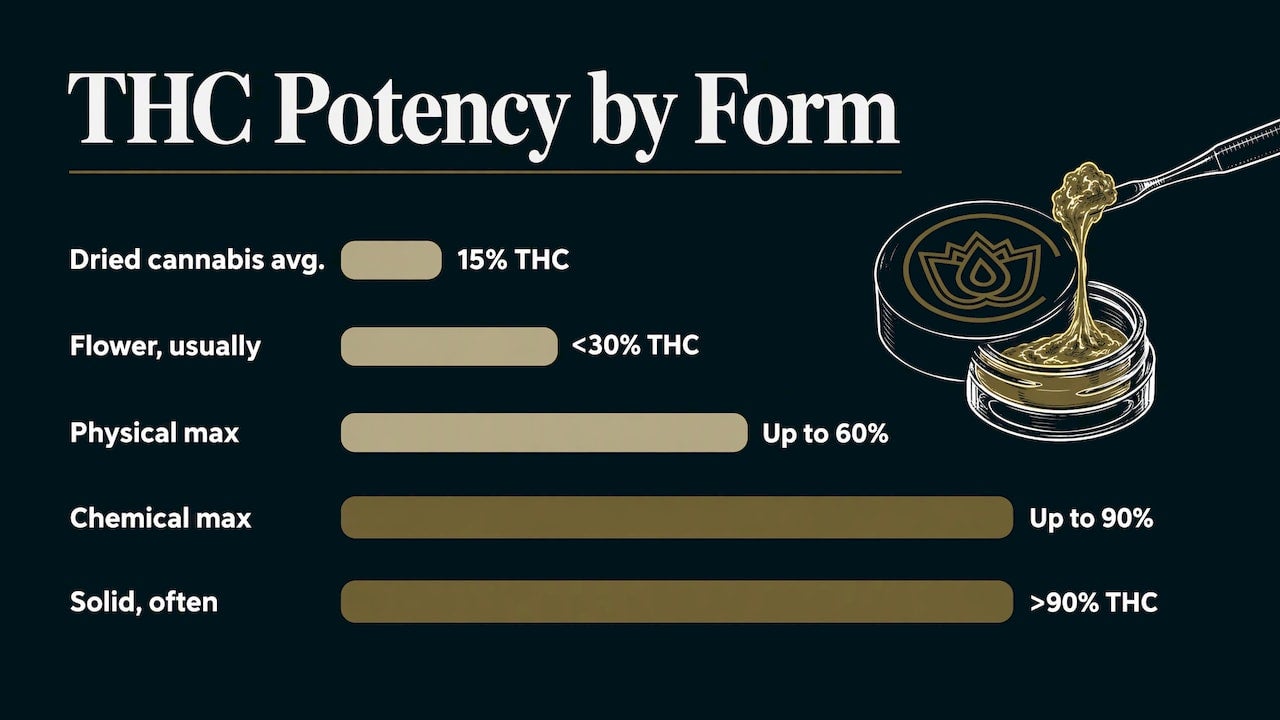
So a small amount of concentrate does the work of a lot of flower. That is why they are popular with experienced users, and why a beginner measures differently.
How much flower makes a gram of concentrate?
For regulatory accounting, Canada treats 0.25 kg of concentrate as equal to 1 kg of dried cannabis, so one gram of concentrate counts as four grams of flower. Real yield varies with the strain, the method and the quality of the starting material.
The main types, in plain words
Quebec’s government lists the inhaled extracts as kief, hashish, bubble hash, shatter, BHO, rosin, budder or badder, crumble and distillate, and the ingested ones as oils, tinctures and oral films. Here is how to tell the common ones apart.
| Type | Texture | How it is made | What a beginner should know |
|---|---|---|---|
| Shatter | Glassy, snaps | Solvent extraction, purged | Easy to portion in small flakes. See our shatter guide. |
| Wax, budder, crumble | Soft, waxy or crumbly | Solvent extraction, whipped or purged differently | Sticky, so a dab tool matters. |
| Sugar wax | Granular, sugar-like | Solvent extraction | Easy to scoop and weigh by eye. |
| Rosin | Sap-like to buttery | Heat and pressure, no solvent | Often chosen by people who prefer a solventless process. |
| Live resin and sauce | Saucy, terpene-rich | Made from fresh-frozen plant | Known for flavour and aroma. |
| Hash and kief | Pressed or powdery | Physical separation | The oldest format; see our hash guide. |
| Distillate | Clear, viscous oil | Refined and purified | Neutral in flavour and common in cartridges. See our distillate guide. |
| Oils and tinctures | Liquid | Extracted and diluted | Taken by mouth, measured in milligrams. |
None of these is a “beginner” type by name. What makes a good first pick is how easily you can control the amount. Liquids you swallow and cartridges with a set puff are easy to measure. Shatter and sugar wax are easy to portion in tiny pieces once you have the right tool.
Choose your format by how you want to use it
How you plan to take a concentrate narrows the choice quickly.
Vape cartridges and pens
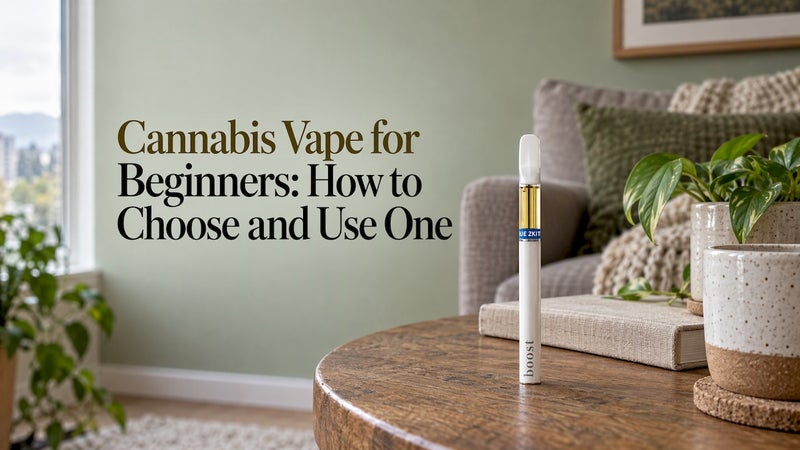
The simplest route. Health Canada describes vaping gear as a battery, mouthpiece, heating element and chamber or cartridge. You press, inhale and put it down, so there is no torch and no tool to learn. Distillate cartridges are the usual starting point.
Dabbing
Dabbing means heating a small amount of concentrate on a hot surface and inhaling the vapour. Health Canada describes a dab rig as a glass device with a dome, dabber, water pipe and a nail or banger, heated with a torch or heating element. It lists wax, hash, rosin, shatter, live resin, budder and crumble among the products used this way. A dab rig takes more setup than a pen, so allow time to learn it before your first session.
Swallowed oils
Oils and tinctures are taken by mouth, and the label must show THC per unit. Under the Cannabis Regulations, the labelled THC in an extract for ingestion cannot exceed 10 mg per unit, which makes dosing much easier to control than with a rig. Our edible dosage guide explains how to think in milligrams.
Read the label before you buy
Health Canada requires the front of a package to display Total THC and Total CBD. A standardized cannabis symbol appears above 10 micrograms per gram of THC, and health warnings sit in a yellow box, updated in early 2025. Extract labels also list ingredients by weight and flag food allergens.
Here is a quick routine:
- Find Total THC. It is your dose guide, either as a percentage or as milligrams per unit.
- Find Total CBD. CBD sits alongside THC and shapes the overall experience. Our CBD dosage guide covers the basics.
- Check the form. Inhaled product, oil or discrete unit? Each is dosed differently.
- Read the ingredients. Cartridges and oils can contain more than the extract itself.
- Buy from an authorized seller. Health Canada advises choosing legal cannabis from authorized retailers.
If you are unsure which percentage suits you, our guide on choosing a THC percentage walks through it, and our cannabis buying guide covers the rest of the label.
How to start: dose, pace and timing
Health Canada’s harm-reduction resource gives starting points for newer users. For ingested products, begin with 2.5 mg THC or less. For inhaled products, it gives 1 to 2 puffs of a product at 10% THC (100 mg/g) or less. The Windsor-Essex County Health Unit adds that for inhaled products you should choose 10% THC or less with equal or higher CBD, wait 4 hours before taking more of an oil or extract, and expect effects to last 12 to 24 hours.
Concentrates sit far above 10% THC, so the lesson for a beginner is about amount. Use the smallest portion you can measure, and let the effect arrive fully before you decide on more. Newer users who like to take it slow often begin with a lower-THC product first. Our guide to low-THC strains is a good way to learn what your body likes before stepping up.
A few habits make a first session go well:
- Pick a calm setting at home with nothing planned afterwards.
- Use one product at a time and keep notes: product, amount, time and how it felt.
- Do not drive or operate machinery afterwards, as the Windsor-Essex County Health Unit advises.
- Do not share vaping devices, and charge batteries as the manufacturer instructs. Health Canada also advises cleaning devices after use and following manufacturer instructions.
Who should take extra care
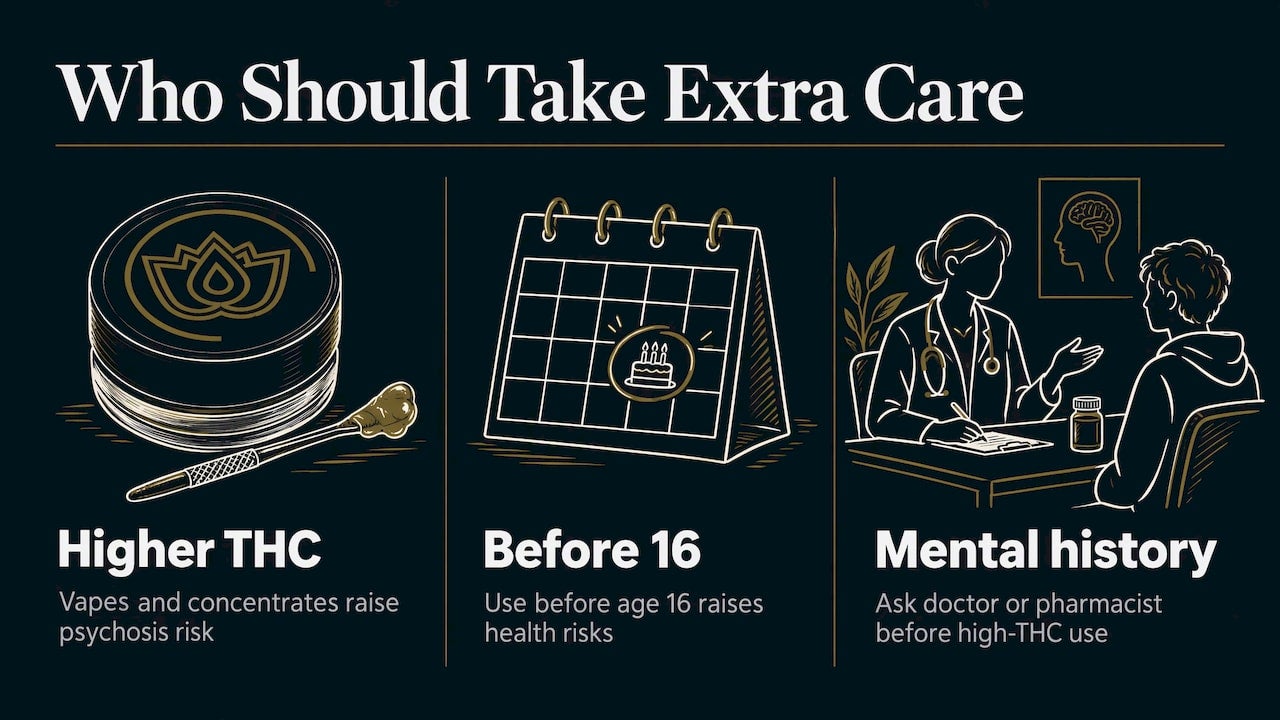
Health Canada says higher-THC products such as vapes and concentrates raise the risk of psychotic symptoms, such as severe paranoia and anxiety, and over time can contribute to dependence and mood and anxiety disorders. The Lower-Risk Cannabis Use Guidelines add that use before age 16 in particular raises health risks. If you have a personal or family history of psychosis or another mental health condition, talk with your doctor or pharmacist before you use any high-THC product.
Your legal limits in Canada
The federal minimum age is 18, but per a University of Calgary review, most provinces set it at 19, with Alberta and Quebec at 18. The same review notes that adults may carry up to 30 grams of dried cannabis or its equivalent in public, and that the concentrate equivalent is 0.25 grams per gram of dried cannabis. In practice that means 7.5 grams of concentrate matches the 30 gram limit. Provincial rules can differ, so check yours.
We build this guide the way we answer questions from first-time buyers.
A beginner does not need the strongest product on the shelf. They need a format they understand, a label they can read and a dose they can repeat. That is why we group our concentrates by type, publish guides on THC percentage, dosing and individual formats like shatter, hash and distillate, and keep our support team available when someone is unsure which product matches the way they plan to use it.
Our concentrates category covers a range of textures and formats, so you can start with something simple and move on as your experience grows. Quality and value matter to us, and so does helping you choose with confidence.
the author
Where to find concentrates online
Our concentrates category lists products such as Sugar Wax, Trichome Gardens CO2 Oil and Cosmic Concentrates Sauce (1g). We offer same-day delivery to Canadian customers of legal age, along with personalized support and educational guides to help you choose. If you are not sure where to begin, start with the guides above and message us with your questions.
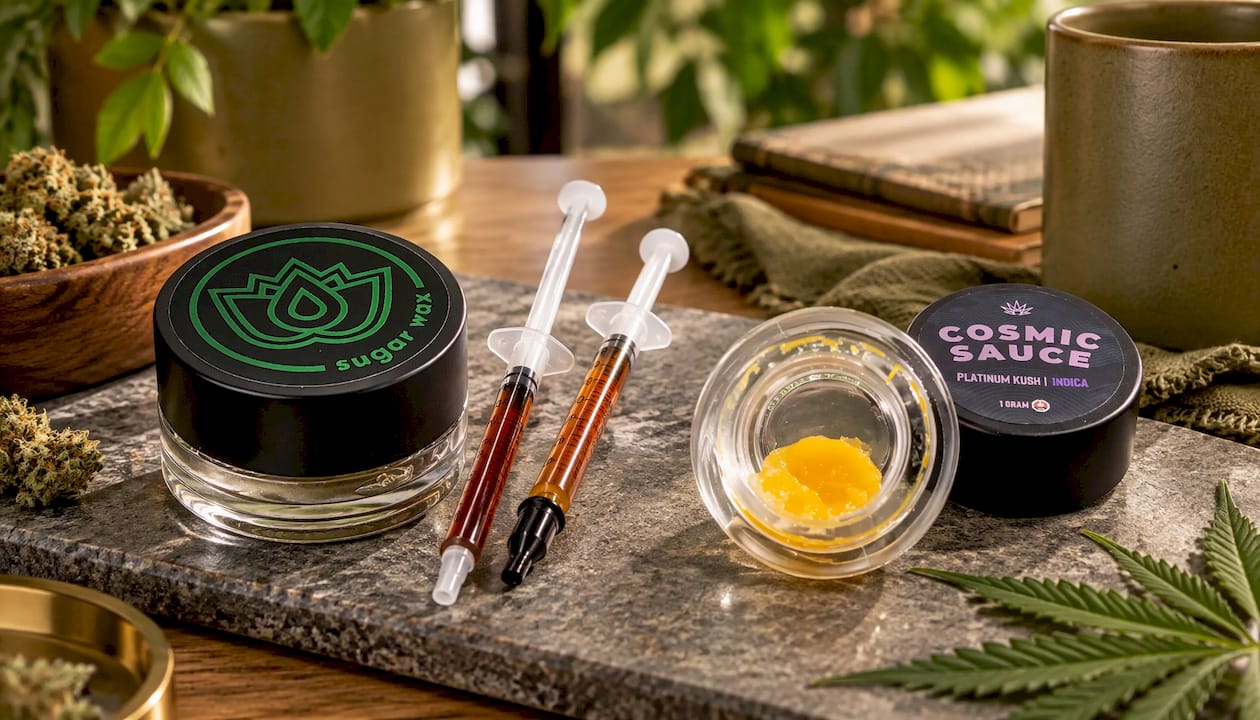
You can also browse everything we carry, from flower and edibles to vape pens, CBD and accessories, on our full product categories page.
FAQ
What is the best cannabis concentrate for beginners?
The best first pick is the one whose dose you can control. A swallowed oil with THC listed per unit or a vape cartridge with a clearly labelled Total THC is easy to measure. Whatever you choose, follow Health Canada’s starting figures of 2.5 mg THC or less ingested, or 1 to 2 puffs inhaled, and wait before taking more.
Which concentrate gives the strongest high?
Potency depends on THC content, and chemically concentrated extracts such as shatter, budder and wax can reach up to 90% THC. The label’s Total THC figure tells you what is in the product you are holding. For a beginner, the useful question is how much to take, so start with a small amount.
What is the most effective way to consume concentrates?
That depends on your gear and comfort. Vape pens and cartridges are the simplest to use, dab rigs are used with wax, shatter, rosin and live resin, and oils are swallowed. Health Canada recommends buying accessories from authorized retailers and following the manufacturer’s instructions.
How much flower does it take to make 1 g of concentrate?
For regulatory purposes, Canada treats one gram of concentrate as equal to four grams of dried cannabis. Actual yield varies with the strain, the extraction method and the quality of the plant material.
Sources
- What You Need to Know About Cannabis Concentrates, First Nations Health Authority
- About cannabis, Health Canada
- Cannabis Regulations (SOR/2018-144), Justice Laws Website
- Cannabis Regulations, section 132.1, Justice Laws Website
- Cannabis Regulations, CanLII
- Forms and methods of cannabis use, Gouvernement du Québec
- Cannabis vaporisation: Understanding products, devices and risks, Drug and Alcohol Review
- How to read and understand a cannabis product label, Health Canada
- Cannabis accessories for inhalation, Health Canada
- Understanding cannabis health effects, Health Canada
- Cannabis: Lower Your Risks, Health Canada
- Lower-Risk Cannabis Use Guidelines FAQ, Health Canada
- Safer Use, Windsor-Essex County Health Unit
- Cannabis and Mental Health: an Environmental Scan, University of Calgary
Recommended
- Cannabis Distillate: Exploring Its Origins, Production, Types, and Consumption Methods
- Dab Rig for Beginners: What to Buy and How to Use It
- The Ultimate Guide to Cannabis Live Resin: Creation, Production, Qualities, and Consumption
- Cannabis Hash: Exploring Its Origins, Production, Types, and Consumption Methods