
News
Edibles Onset Time: How Long They Take to Kick In

Nov
Most people start to feel an edible 30 minutes to 2 hours after eating it. The full effect can take up to 4 hours to arrive, according to Health Canada. That gap is why edibles catch people out. You feel nothing at 45 minutes, eat more, and then both servings hit together. This guide covers what happens in your body, what speeds up or slows down onset, and what to do if an edible seems not to be working or has become too strong.
TL;DR
- Expect the first effects 30 minutes to 2 hours after eating, with the strongest effects around 2 to 4 hours.
- Effects can last up to 12 hours, and some residual effects can linger up to 24 hours.
- Your weight, metabolism, sex, and whether your stomach is empty or full all change the timing.
- If you feel nothing, wait at least 2 hours before a second small dose. Provincial guidance for a second dose runs from 2 to 4 hours.
- If an edible is too strong, stay somewhere safe, do not drive, and call poison control. Call 911 for chest pain, seizures, or panic that will not ease.
Table of Contents
- The typical edible timeline, hour by hour
- Why edibles take so long to work
- What changes your onset time
- Edible not working? What to do before you eat more
- Choosing a starting dose: is 10 mg too much?
- Too high from an edible: what to do
- Our perspective on edible timing
- Find a product to match your pace
- FAQ
- Sources
The typical edible timeline, hour by hour
Top-ranking pages quote slightly different numbers (30 to 90 minutes, 15 to 60 minutes, 30 minutes to 3 hours). The Canadian public health sources agree with each other, so these are the figures to plan around.
| Stage | What to expect | Source |
|---|---|---|
| Onset | 30 minutes to 2 hours after eating | Health Canada |
| Strongest effects | Roughly 2 to 4 hours after eating | Health Canada, medical cannabis guidance |
| Peak | About 4 hours, according to the CCSA | CCSA |
| Duration of effects | Up to 12 hours | Health Canada |
| Residual effects | Could last up to 24 hours | Government of British Columbia |
Health Canada’s medical cannabis page gives a shorter window for how long effects are felt, 4 to 8 hours, while its consumer guidance says up to 12. In practice, plan for a long evening. If you have anything to do the next morning, the 24-hour note on residual effects matters.
Manitoba’s health site adds a detail worth knowing: edible effects can come on very suddenly and then gradually intensify hours after they start, rather than arriving all at once. So a mild feeling at hour one does not tell you where hour three will be.
Why edibles take so long to work
When you inhale cannabis, THC reaches your bloodstream through the lungs within minutes. When you eat it, it has to be digested first.
The CCSA explains that THC travels to the stomach, then the liver, before it reaches your bloodstream and brain. That process varies from person to person, which makes it hard to predict when the full effect will land.
There is a second reason edibles feel different. The Government of Nova Scotia notes that in the liver, THC becomes a more potent compound called 11-hydroxy-THC before it reaches the brain. That is why edibles are slower than smoking or vaping, and why many people describe the experience as heavier and longer.
This also applies beyond gummies. Health Canada’s guidance for adults over 55 says that capsules, softgels, tinctures, oils and edibles, including beverages, can all take up to 4 hours to reach full effect.
What changes your onset time
Two people can eat the same gummy and feel it an hour apart. The Government of British Columbia lists the individual factors: weight, metabolism, sex, and whether you ate on an empty stomach.
Health Canada’s medical cannabis guidance adds three more: the format of the product, other medications you take orally, and the amount or type of food in your stomach.
Here is how that plays out in practice:
- Empty stomach: Onset tends to sit toward the faster end of the range, so the effect can feel sharper. Newer users often prefer to eat a light meal first.
- Full or heavy meal: The edible can take longer to feel. This is the classic “nothing is happening” situation.
- Product format: A chocolate, a gummy, a capsule, and a drink are each digested differently, so the same dose can behave differently.
- Medications: If you take any oral medication, ask a pharmacist or your doctor how cannabis fits with it before you start.
- Tolerance: Manitoba notes that food, alcohol, other drugs, and your tolerance to THC all affect how strongly you feel an edible.
Because so many variables are in play, a single published number cannot tell you your own onset time. The first time you try a new product, treat the whole 4-hour window as your onset window.
Edible not working? What to do before you eat more
Searches for “edible not working” are common, and the answer is almost always the same: it probably has not finished working yet.
Give it enough time
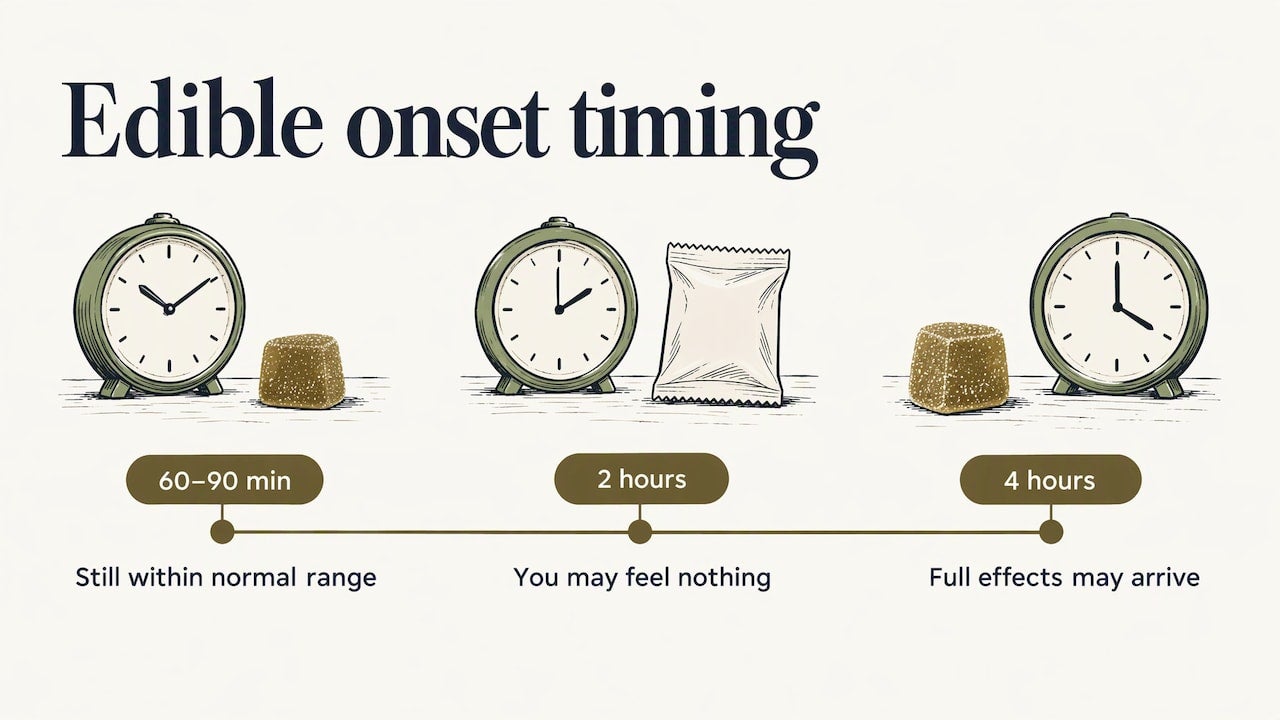
Health Canada and the Windsor-Essex County Health Unit both say you may not feel anything for up to 2 hours, and full effects can be delayed up to 4 hours. If you are at 60 or 90 minutes and feel nothing, you are still inside the normal range.
Wait before a second dose
Canadian provinces give slightly different waiting times, and the safest approach is to follow the longer one if you are unsure:
- Nova Scotia and British Columbia say that if you choose to increase your dose, wait at least 2 hours before taking more.
- Manitoba recommends at least four hours before a second serving.
- Health Canada warns that consuming more within the 4-hour window can increase the risk of adverse effects.
The Council of Chief Medical Officers of Health puts the risk plainly: delayed onset from eaten cannabis can result in overconsumption and raise the risk of poisoning.
A simple plan for the next session
- Eat a small amount of food first, so your timing is more consistent.
- Start with a low dose, 2.5 mg of THC or less if you are new.
- Note the time you ate it and set a reminder for 2 hours.
- Do something relaxing and do not drive while you wait.
- If you still feel nothing at 2 hours and want more, take another small portion, not a large one. Waiting up to 4 hours is the more cautious choice.
- Write down what worked: the product, the dose, what you had eaten, and when you felt it.
If an edible never seems to work for you at all, the dose may simply be too low for your body, or tolerance may play a part. Raise it in small steps over separate sessions, never within the same sitting.
Choosing a starting dose: is 10 mg too much?
In Canada, a package of edible cannabis is legally limited to a maximum of 10 mg of THC, and the CCSA says that people new to edibles should start with no more than 2.5 mg.
So is a 10 mg edible strong for a beginner? The Council of Chief Medical Officers of Health describes 10 mg as a large amount for someone consuming cannabis for the first time or infrequently. Manitoba adds that for some people a 10 mg dose may cause very intense effects, while for others it will not be as strong.
A practical way to read a label:
- First time, or rarely: 2.5 mg of THC or less. If the product is a 10 mg gummy, a quarter is a starting point. Check that the product is made to be divided, and cut it carefully.
- Occasional user: Stay low and move up in small steps across separate sessions.
- Experienced user: You know your range, but onset timing still follows the same 2 to 4 hour pattern, so the waiting rules still apply.
Provincial health sources also note that homemade edibles are riskier, because it is usually not possible to measure the dose accurately. A labelled product with a printed THC amount per piece makes timing and dosing far easier to manage.
Too high from an edible: what to do
If you took too much, or a second dose arrived on top of the first, the most important thing is to know that the feeling passes. Manitoba states that it is possible to overdose on cannabis and that it is not fatal, but can be very uncomfortable, and that overdoses are more common with edibles.
Steps for an uncomfortable but non-emergency situation
- Stay in a safe, comfortable place, ideally with someone you trust.
- Do not drive a vehicle or ride a bicycle.
- Sip water and rest. Effects can take several hours to ease, depending on how the cannabis was consumed.
- For lesser symptoms, contact poison control for advice.
Signs that you need help now
Manitoba says to seek immediate medical attention for chest pain, panic attacks, or seizures. Health Canada’s recall alert lists further signs of very high THC intake, including rapid heartbeat, vomiting, confusion, slurred speech, slowed breathing, and loss of consciousness. In those cases, stop using the product and call a poison centre or 911.
Poison control numbers differ by province. In British Columbia, the BC Poison Control Centre can be reached at 1 800-567-8911 or 604 682-5050. In Nova Scotia the poison control line is 1-800-565-8161. If someone has accidentally eaten cannabis, especially a child, call your poison centre or 911 right away.
Overconsumption can bring extreme sedation, anxiety, paranoia, hallucinations, a racing heart, and slowed breathing, as the BC fact sheet lists. If you are over 55 and experience paranoia, chest pain, confusion, or numbness or weakness in part of your body, Health Canada says to stop using cannabis and contact your health care professional.
Our perspective on edible timing
Most timing mistakes we hear about come from one moment: the 45-minute mark, when nothing has happened yet. Our view is that the best edible experience is a patient one. Pick a product with a clearly labelled THC amount per piece, start small, and let the full window run before you decide anything.
That is why we focus on education alongside selection. Our edibles range includes gummies, candy, and chocolate, and our customer support team can help a first-time buyer match a product format to their comfort level. A small, well-labelled gummy is an easy way to learn your own onset time, because you can note exactly when you took it and when you felt it.
We also built our delivery around convenience. With same-day delivery, you can plan your evening around your edible instead of rushing to buy one, and you can keep a low-dose product on hand for the next time you want to try a different format.
the author
Find a product to match your pace
If you are ready to try an edible, start with our cannabis edibles collection, where you can compare formats. Our cannabis candy and gummies are a natural place to begin because the pieces are easy to portion. We deliver to residents of Canada, and our support team can answer questions about choosing a first product.

Want to read more before you buy? Our guide to why weed gummies are a growing edible choice explains the format, and our glossary of cannabis terms clarifies the labels you will see. You can also browse all our product categories.
FAQ
How long do weed edibles take to kick in?
Usually 30 minutes to 2 hours after eating. Health Canada says full effects can take up to 4 hours. Plan for the whole window the first time you try a product.
Why is my edible not working?
Most often it has not finished working. A full stomach, your metabolism, and body weight can all push onset toward the later end of the range. Wait at least 2 hours, and consider waiting up to 4 hours, before taking a second small dose.
What should I do if an edible is too strong?
Stay somewhere safe, rest, and do not drive. For lesser symptoms, call your provincial poison control line. For chest pain, seizures, or severe panic, call 911 or seek emergency care.
Is a 10 mg edible too much for a beginner?
Public health officials consider 10 mg a large amount for a first-time or infrequent user. Canadian guidance suggests starting with 2.5 mg of THC or less, then waiting before deciding whether to take more.
How long do edible effects last?
Health Canada says effects can last up to 12 hours, with some residual effects lasting up to 24 hours. The strongest effects typically come about 2 to 4 hours after eating.
Sources
- Health Canada: What you need to know if you choose to consume cannabis
- Health Canada: Using a cannabis product (medical purposes)
- Health Canada: Health effects of cannabis on adults over 55
- Health Canada: Cannabis edibles recall alert
- Council of Chief Medical Officers of Health statement on edibles
- Government of Nova Scotia: Edibles, extracts and topicals
- Government of Manitoba: Planning to try it
- Government of Manitoba: Good and bad experiences
- Government of Manitoba: Cannabis myths
- Windsor-Essex County Health Unit: Cannabis edibles
- CCSA: 7 Things You Need to Know about Edible Cannabis
- CCSA: Edible Cannabis, Always Read the Label
Recommended
- Why Weed Gummies are the New Edible Trend
- Indulge in a Blissful Treat: Step-by-Step Guide to Baking Weed-Infused Chocolate Brownies
